Huawei just demonstrated the world’s first single-wavelength 2 terabit-per-second optical solution at Mobile World Congress 2026. That’s 2T on a single DWDM wavelength — at a time when most production SP networks are still running 400G per wavelength and 800G is just ramping up. For service provider engineers, this isn’t just a speed record — it signals where the optical transport layer is heading and why it matters for the IP/MPLS networks you design on top of it.
Key Takeaway: The optical layer is evolving faster than most network engineers realize, driven by AI-generated DCI traffic that’s growing far beyond operator revenue. SP engineers who only understand routing protocols without understanding the transport layer underneath are designing with incomplete information.
What Did Huawei Actually Announce?
According to Developing Telecoms (March 2026), Huawei’s single-wavelength 2T solution delivers three key capabilities:
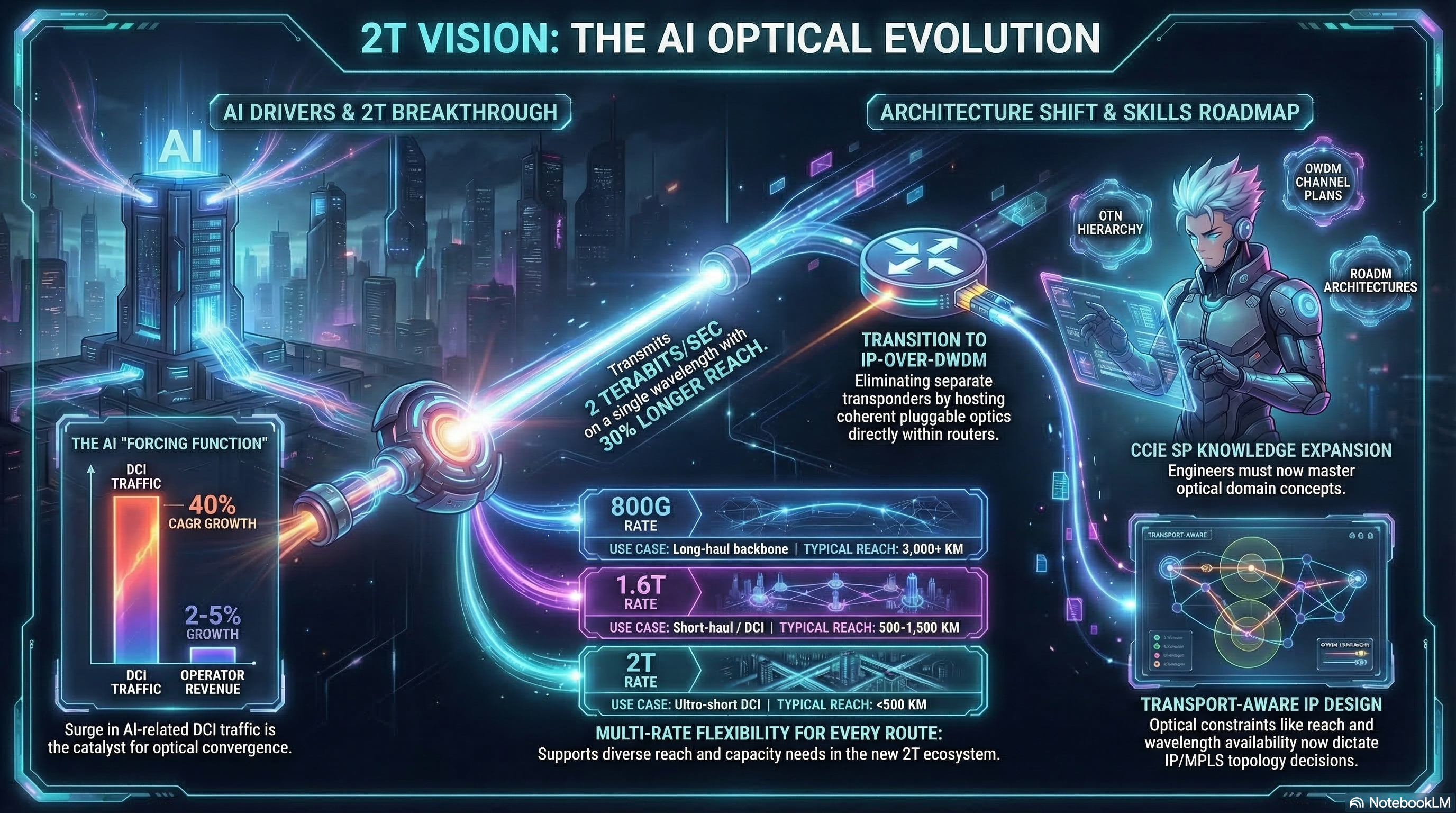
1. Multi-Rate Flexibility (800G/1.2T/1.6T/2T)
The system isn’t locked to 2T — it operates at multiple rates on the same hardware. This is critical for SPs because different routes have different reach and capacity requirements:
| Rate | Use Case | Typical Reach |
|---|---|---|
| 800G | Long-haul backbone, submarine | 3,000+ km |
| 1.2T | Metro/regional backbone | 1,500-2,500 km |
| 1.6T | Short-haul backbone, DCI | 500-1,500 km |
| 2T | Ultra-short DCI, campus interconnect | <500 km |
The tradeoff is fundamental in coherent optics: higher baud rates and modulation orders deliver more capacity but reduce reach. A 2T wavelength won’t span a trans-oceanic cable, but it’s ideal for connecting data centers within a metro area at maximum density.
2. 30% Longer Terrestrial Reach
Huawei claims their 2T solution achieves 30% longer transmission distance than the industry average at comparable rates. In coherent optics, reach is constrained by optical signal-to-noise ratio (OSNR) — longer reach at higher rates requires better DSP performance, lower-noise amplifiers, and advanced modulation techniques.
This matters for SPs designing DCI networks: 30% more reach means fewer regeneration points, fewer amplifier sites, and lower per-bit cost on metro and regional routes.
3. Submarine Cable Support Beyond 1T
The system supports submarine cable rates exceeding 1T per wavelength “over tens of thousands of kilometers.” Submarine cables are the backbone of global internet connectivity, and pushing single-wavelength rates beyond 1T reduces the cost per bit on the most expensive infrastructure in the world.
Commercial Availability
According to Huawei’s announcement, the 2T solution runs on the OSN 9800 platform and has been validated in live network trials with operators in Spain and Türkiye. This isn’t a lab demo — it’s commercially available hardware.
Where Does 2T Fit in the Optical Transport Evolution?
To understand what 2T means, you need to see the progression:
The Coherent Optics Timeline
| Generation | Per-Wavelength Rate | Key DSP/Modem | Status in 2026 |
|---|---|---|---|
| Gen 1 | 100G | Various | Legacy, being retired |
| Gen 2 | 200G | Various | Mature, declining |
| Gen 3 | 400G | Ciena WaveLogic 5e, Nokia PSE-V | Mainstream production |
| Gen 4 | 800G | Ciena WaveLogic 6 Nano, Nokia PSE-6s | Ramping in production |
| Gen 5 | 1.2T-1.6T | Ciena WaveLogic 6, Infinera ICE-7 | Early deployment |
| Gen 6 | 2T | Huawei (first to demo) | Commercial trials |
According to Cignal AI (2025), 800G coherent pluggable shipments will exceed $1 billion in revenue in 2026, and the total pluggable coherent market will grow to nearly $5 billion by 2029. Cloud operators will account for over 80% of this spending.
The Competitive Landscape
Huawei claims the “industry first” for 2T, but the competition is close:
Ciena — WaveLogic 6 supports 1.6T per wavelength and is in broad commercial rollout in 2026. According to SM Daily Press (February 2026), WaveLogic 6 is driving “a massive replacement cycle for older 400G and 800G systems.” Ciena is also entering co-packaged optics for inside-the-rack applications.
Nokia — PSE-6s powers Nokia’s 800G ZR/ZR+ pluggable modules for IP-over-DWDM architectures. According to Nokia’s blog, 800G ZR/ZR+ is “the new currency in AI-scale connectivity.”
Infinera — ICE-7 engine targets 1.2T-1.6T per wavelength for long-haul and submarine applications.
The key distinction: Huawei’s 2T is demonstrated on a purpose-built OTN platform (OSN 9800), while Ciena and Nokia are also pushing coherent optics into pluggable form factors that fit directly into routers — eliminating the need for separate optical transport equipment in some architectures.
Why Is AI Traffic the Forcing Function?
Huawei’s announcement explicitly names the driver: “With the popularity of AI, DCI and transit traffic has surged far beyond operators’ revenue growth.”
The DCI Bandwidth Explosion
AI training clusters are distributed across multiple data centers, connected by DCI links. A single large language model training run can generate petabytes of data flowing between sites daily. This traffic flows over SP DWDM networks.
The math is brutal for operators:
- Traffic growth: 30-40% CAGR in DCI bandwidth demand
- Revenue growth: 2-5% CAGR in SP transport revenue
- Result: Operators must reduce per-bit cost by 20-30% annually just to maintain margins
Higher per-wavelength rates are the most efficient lever. Doubling the rate per wavelength on existing fiber infrastructure halves the per-bit cost without deploying new fiber — which costs $20,000-$50,000 per kilometer in urban areas.
IP-over-DWDM: The Architecture Shift
According to WWT’s optical networking trends analysis, the industry is shifting to IP-over-DWDM architectures where routers host coherent pluggable optics directly. Instead of Router → Transponder → DWDM mux → fiber, the architecture becomes Router (with coherent pluggable) → DWDM mux → fiber.
This eliminates the transponder layer entirely — reducing cost, power, and latency. The 400ZR and 800ZR+ standards define coherent pluggable modules that fit in QSFP-DD or OSFP form factors on Cisco, Arista, and Juniper routers.
For SP engineers, this means the boundary between “IP/MPLS engineer” and “optical transport engineer” is blurring. Understanding both layers is becoming essential.
What Does This Mean for CCIE SP Candidates?
OTN Fundamentals on the Blueprint
The CCIE SP v5.0 blueprint includes OTN (Optical Transport Network) fundamentals. While you won’t configure DWDM systems in the lab, you need to understand:
- OTN hierarchy — ODU0/1/2/3/4/flex and OTU mapping
- DWDM channel plans — C-band wavelength grid, channel spacing (50GHz, 75GHz, 100GHz)
- Reach vs. capacity tradeoffs — why higher modulation orders (16QAM, 64QAM) deliver more capacity but less reach
- ROADM architectures — how reconfigurable optical add-drop multiplexers enable dynamic wavelength routing
How Transport Affects IP/MPLS Design
The optical layer constrains your IP/MPLS topology design:
Fiber topology ≠ IP topology — You can’t create an IP adjacency between two routers unless there’s an optical path between them. Understanding DWDM constraints (reach, amplifier spacing, wavelength availability) affects where you place P routers and how you design your IS-IS backbone.
Capacity planning — Each DWDM wavelength carries a fixed rate (400G, 800G, 1.6T). The number of wavelengths on a fiber pair determines total capacity. When you design Segment Routing TE policies, the underlying optical capacity is the ceiling.
Protection and restoration — Optical layer protection (1+1, shared mesh) is typically faster than IP/MPLS FRR. Understanding which layer provides protection for which failure scenario is a design decision that affects convergence time and capacity efficiency.
Silicon Photonics Connection
As we covered in our STMicro silicon photonics analysis, the underlying semiconductor technology (PIC100, co-packaged optics) is what enables these higher rates. Huawei’s 2T solution uses proprietary DSP silicon, while the broader industry is converging on silicon photonics for pluggable form factors.
The two technologies serve different segments:
- Proprietary DWDM platforms (Huawei OSN 9800, Ciena 6500) — purpose-built for long-haul and submarine
- Pluggable coherent optics (400ZR, 800ZR+) — fits in routers for DCI and metro IP-over-DWDM
Career Implications
SP engineers who understand both the IP/MPLS layer and the optical transport layer are commanding premium salaries. As we noted in our CCIE SP salary analysis, CCIE SP holders earn $158K average — and those with optical networking expertise on top of routing/switching skills are at the upper end of that range.
The convergence of IP and optical layers means the traditional job boundary (“I’m a router engineer, not an optical engineer”) is dissolving. Engineers who can have intelligent conversations about both DWDM channel plans and BGP EVPN overlays are the ones getting the architect-level roles.
What Should You Watch Next?
Three developments will shape the optical transport landscape through 2027:
800G ZR/ZR+ pluggable adoption — watch for broad deployment in router platforms from Cisco (Silicon One), Arista, and Juniper. This is the technology that eliminates dedicated transponders for DCI.
1.6T pluggable standards — the industry is working on 1.6T coherent pluggable specifications. When these ship, the IP-over-DWDM architecture extends to higher rates without external OTN equipment.
Co-packaged optics (CPO) for transport — currently focused on intra-DC applications, CPO may eventually extend to DCI, further integrating optical and switching functions.
Frequently Asked Questions
What is Huawei’s single-wavelength 2T optical solution?
Announced at MWC 2026, it’s the first commercially available system that transmits 2 terabits per second on a single DWDM wavelength. It supports multi-rate operation (800G, 1.2T, 1.6T, 2T), achieves 30% longer terrestrial reach than industry average, and supports submarine cable rates beyond 1T.
Why does AI traffic drive the need for 2T per wavelength?
AI training and inference generate massive data center interconnect traffic between distributed GPU clusters. This DCI traffic has surged far beyond operators’ revenue growth. Higher per-wavelength rates reduce per-bit network construction costs without deploying new fiber.
How does 2T per wavelength compare to current DWDM technology?
Most production DWDM networks run 400G per wavelength today, with 800G ramping in 2026. The progression is 400G → 800G → 1.2T → 1.6T → 2T. Each generation roughly doubles capacity per wavelength, reducing the number of wavelengths needed for the same total capacity.
Do CCIE SP candidates need to understand DWDM and optical transport?
Yes. The CCIE SP v5.0 blueprint covers OTN fundamentals. More importantly, SP backbone design increasingly requires understanding how DWDM constraints affect IP/MPLS topology decisions and Segment Routing path computation.
How does Huawei’s 2T compare to Ciena and Nokia solutions?
Ciena’s WaveLogic 6 supports 1.6T per wavelength in commercial production, with an 800G coherent router platform. Nokia’s PSE-6s powers 800G ZR/ZR+ pluggable modules. Huawei claims the “industry first” for 2T, but the key differentiator is form factor — Huawei uses a purpose-built OTN platform while Ciena and Nokia also offer pluggable coherent optics for routers.
The optical transport layer is evolving at a pace that makes the 400G-to-800G transition look slow. As a service provider engineer, understanding how DWDM capacity, reach, and architecture decisions affect your IP/MPLS design is becoming as important as understanding BGP and IS-IS. The engineers who bridge both layers will define the next generation of SP network architecture.
Ready to fast-track your CCIE journey? Contact us on Telegram @phil66xx for a free assessment.