Alcatel Submarine Networks (ASN) has declared force majeure on the Persian Gulf segment of Meta’s 2Africa Pearls extension, indefinitely halting work on one of the most critical subsea cable projects connecting the Middle East to global internet infrastructure. The cable-laying vessel Ile De Batz sits stranded off Dammam, Saudi Arabia, unable to complete connections to onshore landing stations — and this is just the beginning of what SP engineers need to worry about.
Key Takeaway: The simultaneous closure of the Red Sea and Strait of Hormuz to cable operations is an unprecedented dual chokepoint failure. For CCIE SP engineers, this is no longer a theoretical exam scenario — it’s a real-world convergence event that demands you understand exactly how BGP, MPLS-TE, and physical layer diversity interact when submarine cables go dark.
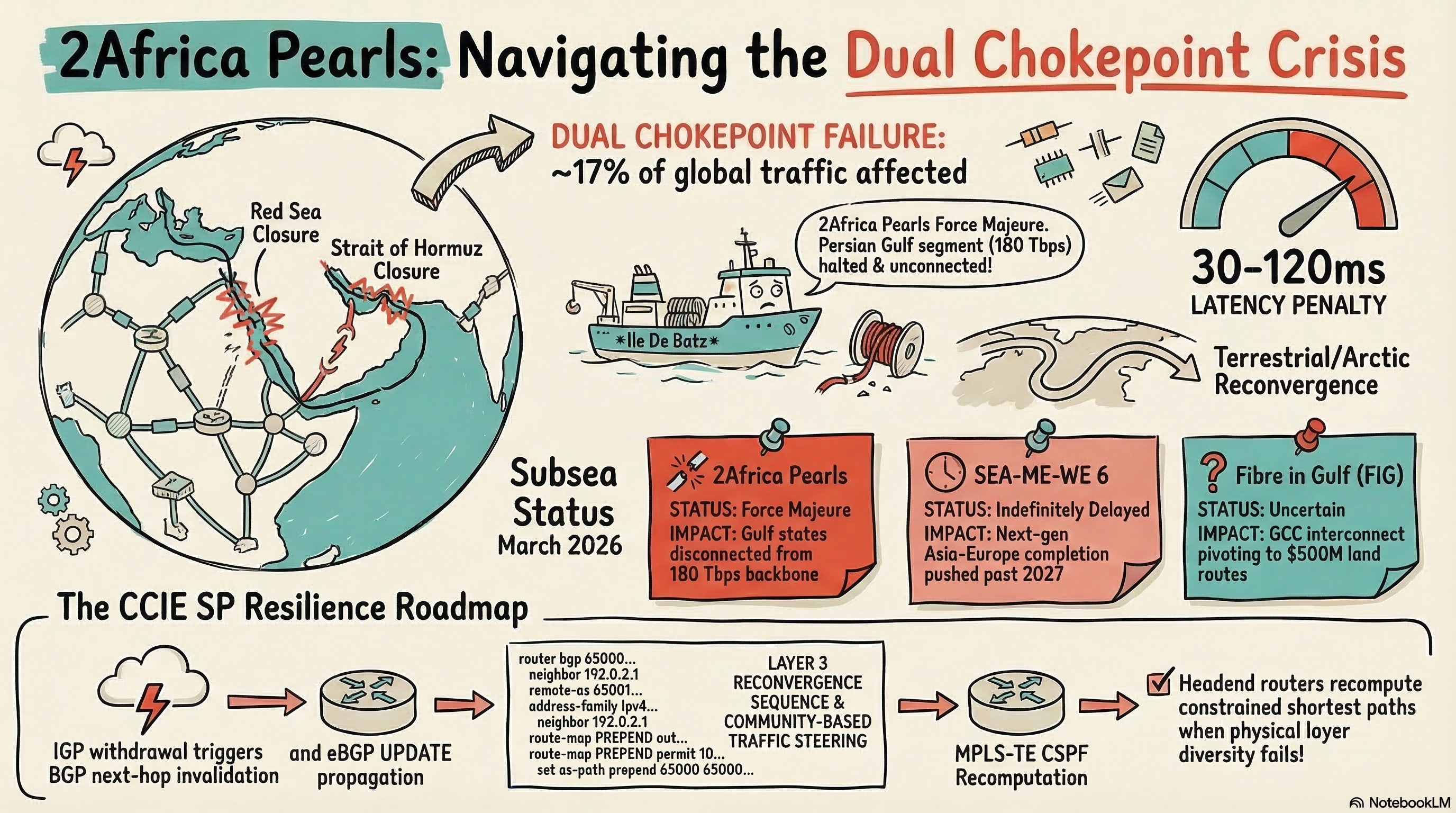
What Is 2Africa Pearls and Why Does It Matter?
The 2Africa cable system is the world’s longest open-access subsea cable at 45,000 kilometers, connecting 33 countries across Africa, Asia, and Europe with a design capacity of 180 Tbps across 16 fiber pairs using spatial division multiplexing (SDM). According to Meta’s engineering blog (2025), the core 2Africa system was completed in November 2025, with 46 landing points serving over 3 billion people.
The Pearls extension was designed to connect Persian Gulf states — Iraq, Kuwait, Saudi Arabia, Bahrain, Qatar, UAE, and Oman — plus Pakistan and India to the broader 2Africa backbone. It was supposed to go live in 2026.
Here’s why SP engineers should care: 2Africa Pearls was positioned as a critical alternative to the Red Sea corridor, which has faced repeated disruptions from Houthi attacks since 2024. With both routes now compromised, the region faces what SubmarineNetworks.com calls “the first simultaneous closure of both chokepoints in history.”
| Cable System | Status (March 2026) | Capacity | Impact |
|---|---|---|---|
| 2Africa Pearls (Persian Gulf) | Force majeure — halted | Part of 180 Tbps system | Gulf states disconnected from 2Africa backbone |
| 2Africa Red Sea segment | Delayed (Houthi risk) | Part of 180 Tbps system | Africa-Europe path constrained |
| SEA-ME-WE 6 Gulf Extension | Indefinitely delayed | Next-gen Asia-Europe | Completion pushed past 2027 |
| Fibre in Gulf (FIG) | Uncertain | GCC interconnect | Ooredoo pivoting to $500M land route |
| WorldLink Transit Cable | Effectively dead | Asia-Europe transit | Entire business case collapsed |
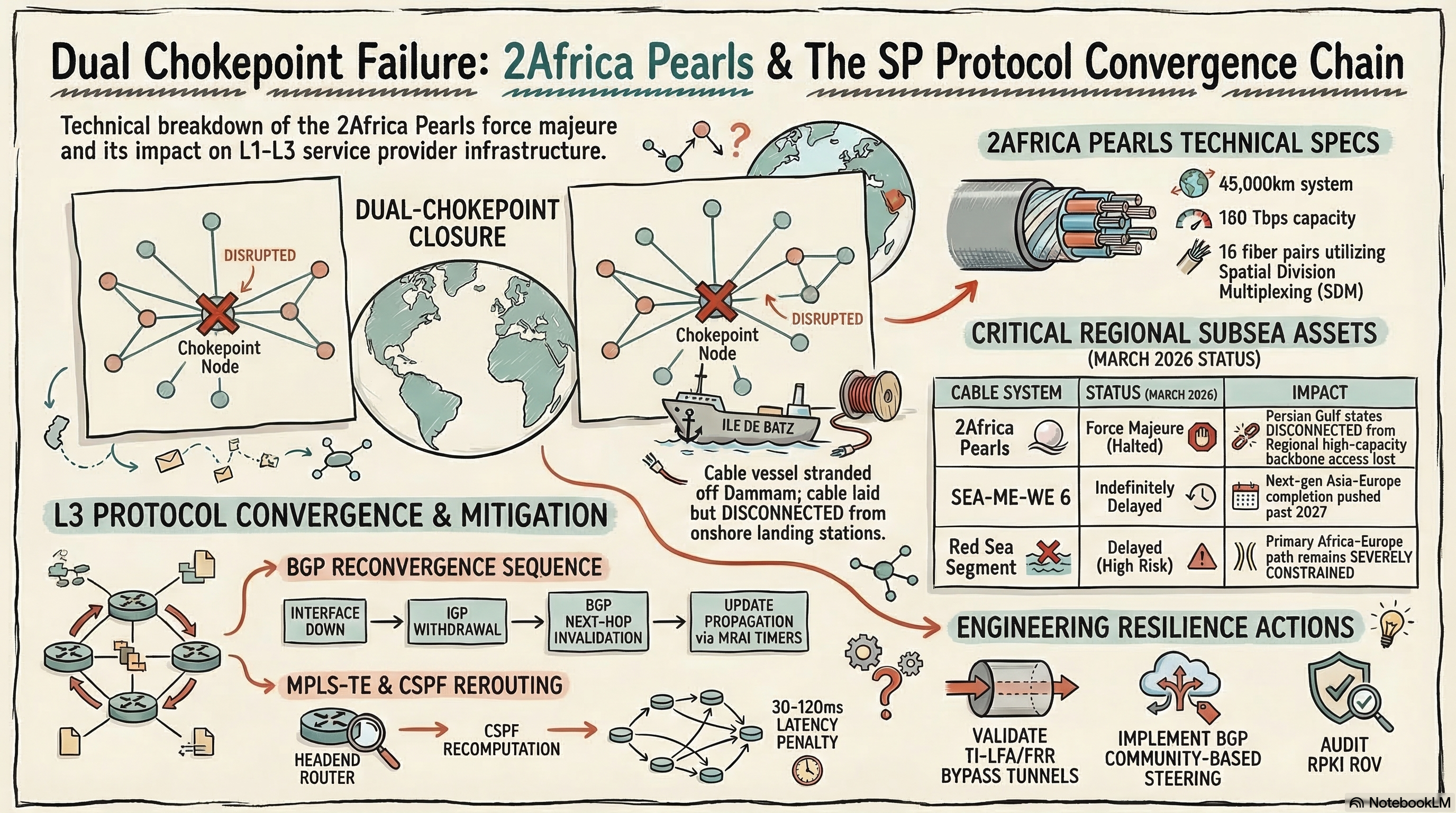
What Happens at the Protocol Level When a Subsea Cable Goes Dark?
When a major submarine cable segment fails, the impact cascades through multiple layers of the SP network stack. This is where your CCIE SP training transitions from lab exercises to operational reality.
Layer 1 — Physical Detection: Submarine line terminal equipment (SLTE) at the cable landing station detects loss of light within milliseconds. The optical transport network triggers alarms and protection switching if available. Most modern submarine systems use reconfigurable optical add-drop multiplexers (ROADMs) that can reroute wavelengths — but only within the same cable system. When the entire cable is down, there’s no Layer 1 fix.
Layer 3 — BGP Reconvergence: This is where things get interesting for SP engineers. Here’s the sequence:
- Interface down triggers IGP withdrawal (IS-IS or OSPF LSA flush) on the PE router connected to the cable landing station
- BGP next-hop becomes unreachable — the BGP scanner process invalidates all prefixes using that next-hop
- BGP UPDATE messages propagate withdrawal to eBGP peers — this takes seconds to minutes depending on MRAI timers and route dampening configuration
- Alternate paths activate from other eBGP peers advertising the same prefixes through different submarine cables
! Example: Monitoring BGP convergence during a cable event
router# show bgp ipv4 unicast summary | include Idle|Active
! Watch for sessions transitioning to Idle — indicates next-hop failure

router# show bgp ipv4 unicast neighbors 203.0.113.1 | include Prefix
! Track prefix count dropping on the affected peer

router# show bgp ipv4 unicast | include 0.0.0.0/0
! Verify default route is now pointing to alternate transit provider
MPLS-TE Reroutes: If you’re running MPLS Traffic Engineering (which most large SPs do for premium traffic), the headend router detects the path failure and triggers CSPF recomputation:
! MPLS-TE FRR verification
router# show mpls traffic-eng tunnels brief
! Check for tunnels in "Oper: down" or "Rerouted" state

router# show mpls traffic-eng fast-reroute database
! Verify FRR backup tunnels activated

router# show mpls traffic-eng topology | include link
! Review available bandwidth on alternate CSPF paths
According to ThousandEyes’ analysis of the September 2025 Red Sea cable cuts, traffic automatically shifted to alternative routes — often through terrestrial networks across Asia — but with significant latency penalties of 30-120ms on affected paths.
The September 2025 Red Sea Cuts — A Preview of What’s Coming
The September 2025 Red Sea cable cuts near Jeddah, Saudi Arabia provide a concrete case study. According to DataCenterDynamics (September 2025), the SMW4 and IMEWE cables were severed, impacting services in India, Pakistan, and the UAE. Microsoft Azure experienced measurable latency degradation on Asia-Europe paths, with the company noting “higher latency on some traffic” as regional carriers triaged routes.
According to Network World (2025), the event reinforced what the February 2024 Red Sea cuts had already demonstrated — when three cables were simultaneously damaged, internet connectivity between Asia, Africa, and Europe suffered significant degradation. That 2024 event took nearly six months to fully repair.
What made the 2025 incident instructive, according to ThousandEyes’ Internet Report, “wasn’t the cable damage itself — submarine cables break regularly — but understanding the varying impacts.” Traffic automatically shifted to alternative routes, but workloads relying on specific Asia-Europe low-latency paths experienced real performance degradation.
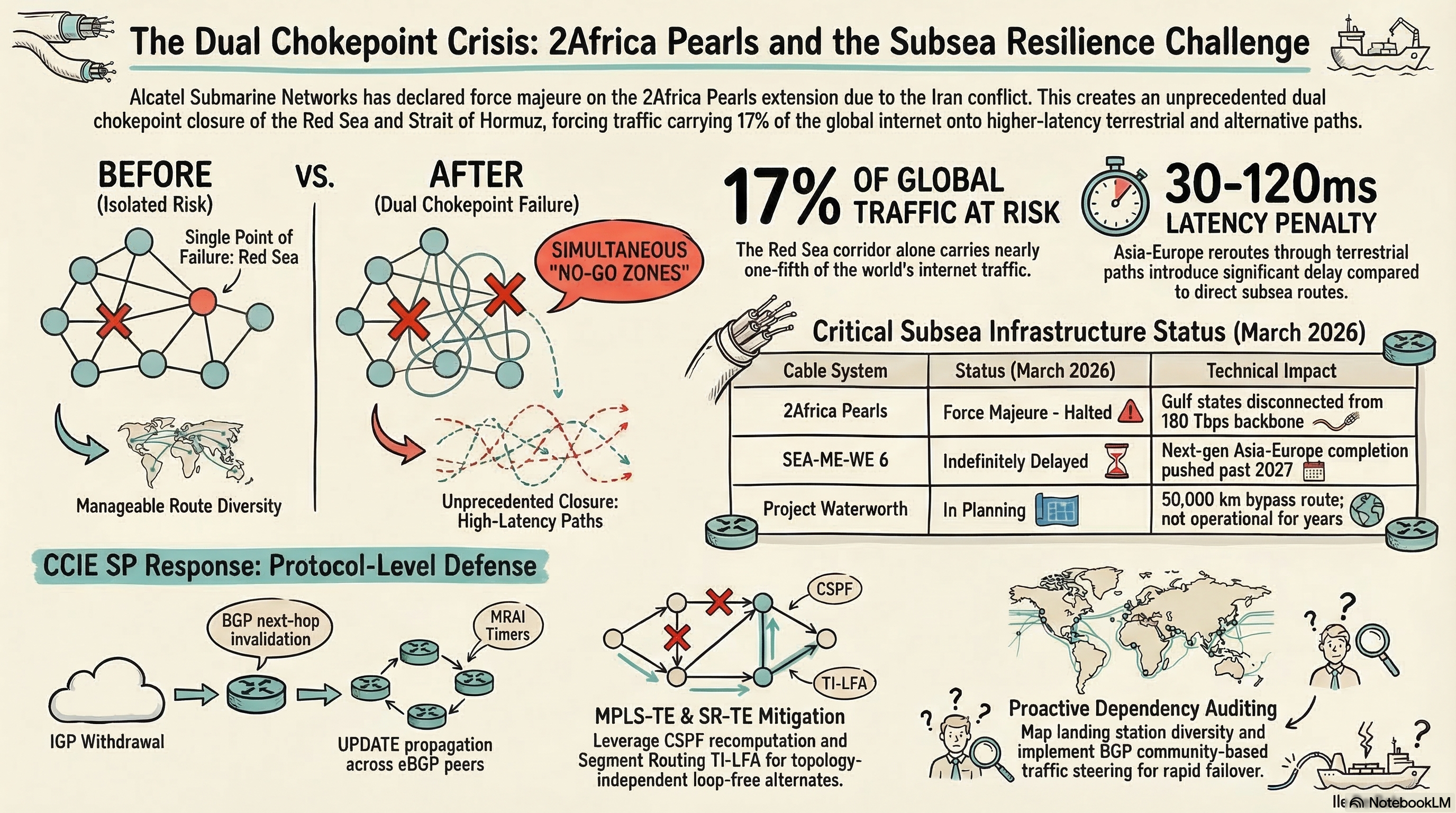
Now multiply that by both chokepoints being closed simultaneously. According to SubmarineNetworks.com (March 2026), the Red Sea corridor carries approximately 17% of global internet traffic through a dense cluster of cables. The Persian Gulf adds another significant chunk. The math is sobering.
How the Iran Conflict Escalated from Cables to Data Centers
The subsea cable disruption is part of a broader pattern of infrastructure targeting. According to Tom’s Hardware (March 2026), the Iran conflict hasn’t just stalled cable projects — Iranian drone strikes have hit three AWS data centers in the UAE and Bahrain, and Iran has threatened tech firms operating in the region, declaring “economic centers and banks” as legitimate targets.
For SP engineers operating in or peering with Middle Eastern networks, this creates a cascading risk profile:
| Risk Layer | Impact | SP Engineer Action |
|---|---|---|
| Physical cable damage | Total path loss | Pre-configure diverse BGP peers on alternate cables |
| Cable ship access denied | No repair for months | Ensure capacity headroom on surviving paths |
| Landing station damage | Regional isolation | Map landing station diversity across providers |
| Data center strikes | Compute + networking loss | Validate disaster recovery routing policies |
| Cyber operations | BGP hijacking, DDoS | Implement RPKI ROV, flowspec, RTBH |
This is precisely the multi-layered failure scenario that CCIE SP candidates study — but rarely encounter at this scale in production.
What SP Engineers Should Do Right Now
The practical response breaks down into immediate actions and strategic planning.
Audit Your Submarine Cable Dependencies
Most enterprise and SP networks don’t explicitly track which submarine cables carry their transit traffic. That needs to change.
! Step 1: Identify your transit providers' submarine cable paths
router# show bgp ipv4 unicast neighbors
! List all eBGP peers

! Step 2: For each transit provider, determine:
! - Which submarine cables carry your traffic to key destinations
! - Landing station locations (are multiple cables at the same station?)
! - Provider's stated cable diversity

! Step 3: Use BGP communities to verify path diversity
router# show bgp ipv4 unicast 1.1.1.0/24 bestpath
! Check AS-path — are alternate paths truly on different physical cables?
Pre-Position BGP Failover with Communities
If you’re multihomed across providers using different submarine systems, configure community-based traffic steering so you can rapidly shift traffic away from affected paths:
! Example: Prepend-based steering away from Red Sea transit
route-map STEER-AWAY-REDSEA permit 10
  match community RED-SEA-TRANSIT
  set as-path prepend 65000 65000 65000

! Apply during cable event to deprefer Red Sea paths
router(config)# router bgp 65000
router(config-router)# neighbor 203.0.113.1 route-map STEER-AWAY-REDSEA in
Validate MPLS FRR Bypass Tunnels
Ensure your Fast Reroute backup paths have adequate bandwidth and don’t route through the same physical infrastructure:
! Verify FRR protection coverage
router# show mpls traffic-eng tunnels protection
! Target: 100% FRR coverage on all primary tunnels

! Validate backup path diversity
router# show mpls traffic-eng tunnels tunnel-te100 detail
! Check: Does the backup path use a different submarine cable system?
Monitor with Real-Time Telemetry
Deploy model-driven telemetry for submarine-connected interfaces:
<!-- YANG subscription for interface optical power monitoring -->
<subscription>
  <sensor-path>
    Cisco-IOS-XR-controller-optics-oper:optics-oper/optics-ports/optics-port
  </sensor-path>
  <sample-interval>10000</sample-interval> <!-- 10-second polling -->
</subscription>
The Emerging Alternative Routes — What SP Engineers Should Watch
The industry response to dual chokepoint failure is accelerating alternative route development. According to SubmarineNetworks.com (March 2026), three major alternatives are emerging:
Trans-Caspian Middle Corridor: Running through Kazakhstan, across the Caspian Sea, through Azerbaijan and Georgia, then via the Black Sea to Romania — roughly 7,000 km. It bypasses Russia and the Middle East but requires multiple border crossings and sea transits.
Saudi Arabia Terrestrial Bridge: stc’s center3 national fiber backbone from Al Khobar on the Gulf coast to Yanbu or Duba on the Red Sea coast — over 1,000 km of terrestrial fiber. SEA-ME-WE 6 was designed to use this hybrid subsea-terrestrial architecture, but the Gulf end is now compromised.
Arctic Route (Polar Connect): A submarine cable through the Arctic Ocean connecting Europe, North America, and East Asia — scheduled for approximately 2030. According to SubmarineNetworks.com, it has been designated a Cable Project of European Interest (CPEI) by the EU with dedicated funding. This represents the most radical rerouting — and the longest timeline.
For SP engineers planning capacity, Meta’s Project Waterworth — a 50,000 km cable bypassing the Middle East entirely to connect the US, Brazil, South Africa, India, and Australia — represents the hyperscaler response. But according to Tom’s Hardware (March 2026), it’s “several more years” from completion.
What This Means for CCIE SP Candidates
If you’re studying for CCIE Service Provider, the 2Africa Pearls crisis is a master class in concepts you’ll be tested on:
- BGP convergence mechanics — understanding MRAI timers, route dampening, and how eBGP peer failures propagate
- MPLS-TE path protection — FRR facility backup vs one-to-one backup, CSPF recomputation behavior
- IS-IS/OSPF reconvergence — how IGP events trigger BGP next-hop invalidation
- Traffic engineering during failures — using RSVP-TE make-before-break to shift traffic without packet loss
- Segment Routing TI-LFA — the modern replacement for RSVP-TE FRR, providing topology-independent loop-free alternates
The key insight: lab scenarios simulate single link failures. Real-world submarine cable events create correlated multi-link failures across an entire geographic corridor. Your ability to handle this at scale — precomputing diverse paths, sizing backup capacity, and implementing policy-based failover — is what separates a CCIE SP from someone who passed a practice exam.
For a deeper dive into the SP track and its career value, see our guide on whether CCIE SP is still worth pursuing and our Segment Routing vs MPLS-TE comparison.
Frequently Asked Questions
What happened to the 2Africa Pearls subsea cable?
Alcatel Submarine Networks declared force majeure in March 2026, halting work on the Persian Gulf segment connecting Iraq, Kuwait, Saudi Arabia, Bahrain, Qatar, UAE, Oman, Pakistan, and India. According to Bloomberg (March 2026), the bulk of the cable has been laid on the seabed but remains unconnected to onshore landing stations. The cable-laying vessel Ile De Batz is stranded off Dammam, Saudi Arabia.
How does a subsea cable outage affect internet routing?
When a submarine cable fails, BGP withdraws prefixes reachable through that path and reconverges traffic through alternate routes. MPLS-TE headend routers recompute constrained shortest paths via CSPF. According to ThousandEyes’ analysis of the 2025 Red Sea cuts, this typically adds 30-120ms of latency depending on the geographic length of the alternate route.
How many subsea cables pass through the Red Sea and Persian Gulf?
Approximately 16 subsea cable systems transit the Red Sea corridor, carrying roughly 17% of global internet traffic according to SubmarineNetworks.com. The Persian Gulf hosts additional systems including 2Africa Pearls, SEA-ME-WE 6 Gulf Extension, Fibre in Gulf (FIG), and the now-canceled WorldLink Transit Cable.
What is Meta’s backup plan for 2Africa?
Meta announced Project Waterworth — a separate 50,000 km cable designed to bypass the Middle East entirely, connecting the US, Brazil, South Africa, India, and Australia. According to Tom’s Hardware (March 2026), it won’t be operational for several years. In the interim, traffic relies on surviving cable systems and terrestrial alternatives.
What should CCIE SP engineers do to prepare for subsea cable disruptions?
Audit your submarine cable dependencies across transit providers. Ensure BGP multihoming across providers using physically diverse cable systems. Configure MPLS FRR bypass tunnels with verified path diversity and adequate bandwidth. Implement BGP community-based traffic steering for rapid manual failover. Deploy real-time telemetry on submarine-connected interfaces to detect degradation before total failure.
The 2Africa Pearls suspension is a wake-up call for every SP engineer who assumed physical infrastructure was someone else’s problem. The protocols you master in your CCIE studies — BGP, MPLS-TE, IS-IS — are exactly the tools that keep the internet running when submarine cables go dark. Build your resilience plan now, not after the next cable cut.
Ready to deepen your CCIE Service Provider skills? Contact us on Telegram @phil66xx for a free assessment.