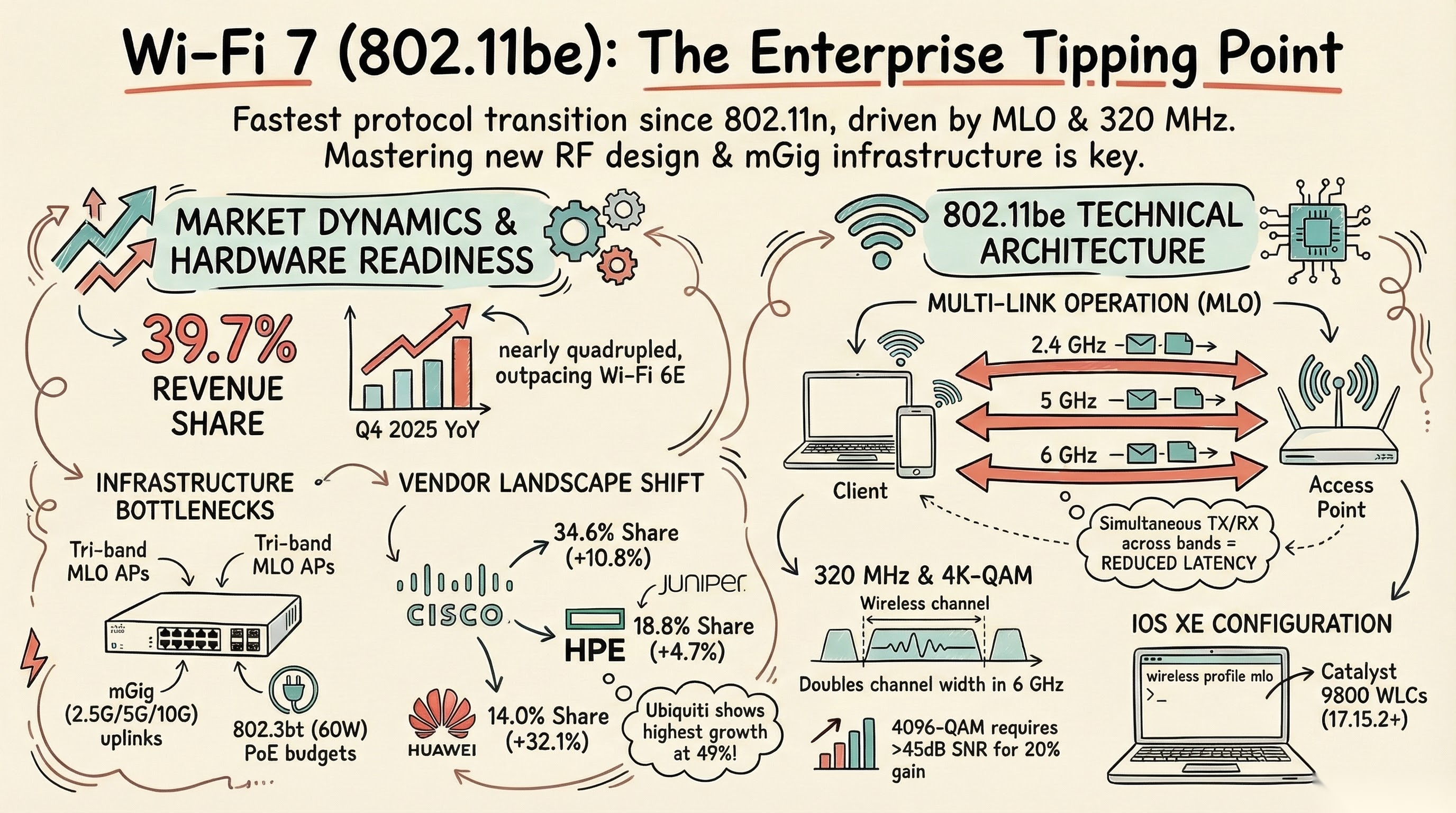
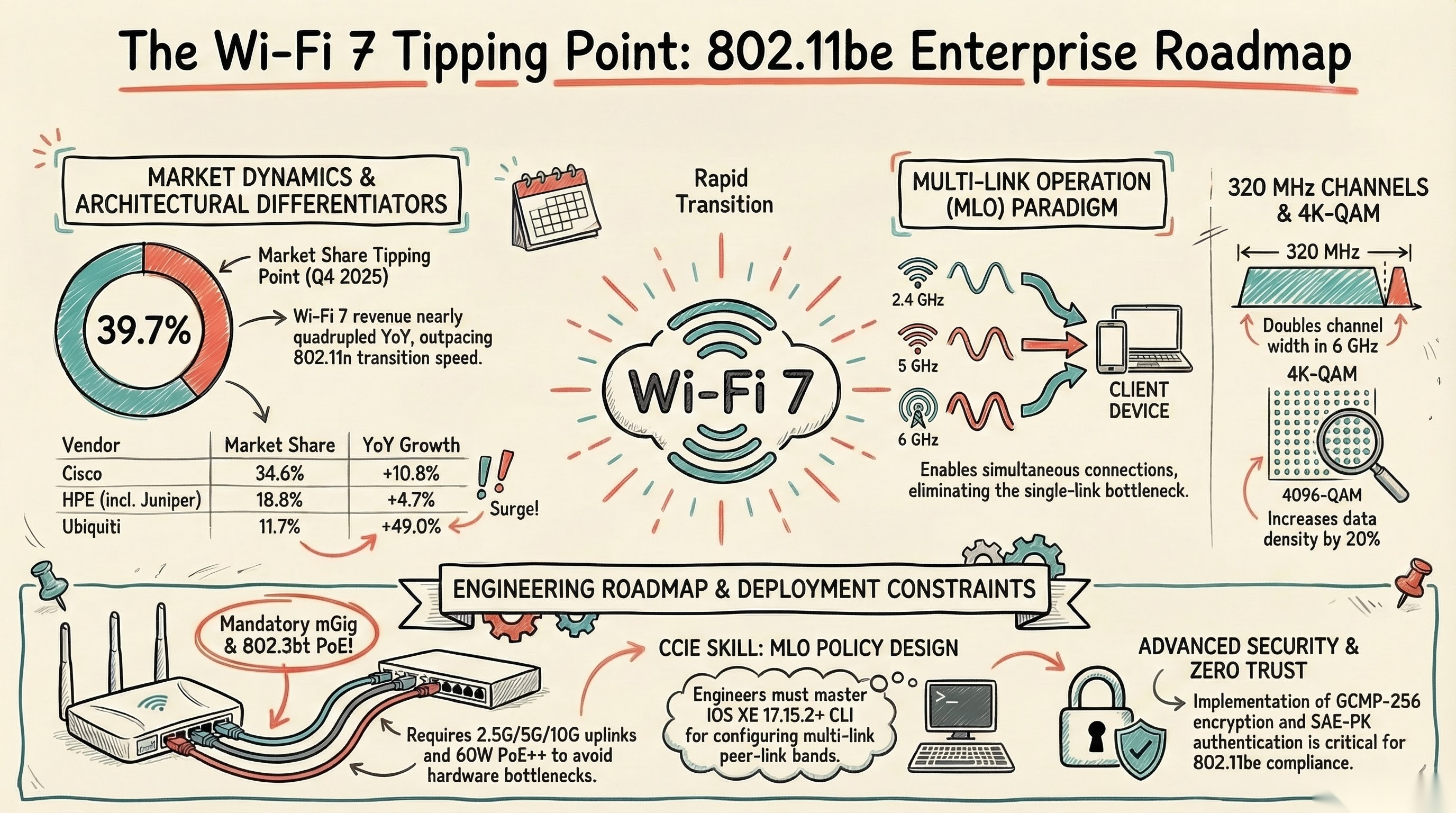
Wi-Fi 7 (802.11be) has officially crossed the tipping point in enterprise networking. According to IDC’s Q4 2025 Worldwide WLAN Tracker published on March 19, 2026, Wi-Fi 7 now accounts for 39.7% of all dependent access point segment revenue — nearly quadrupling from 10.25% just one year earlier. The worldwide enterprise WLAN market hit $2.9 billion in Q4 2025 alone, growing 13.9% year over year, with Wi-Fi 7 serving as the primary growth engine.
Key Takeaway: Wi-Fi 7 is the fastest enterprise wireless generation transition since 802.11n, and network engineers who delay building MLO and 320 MHz channel design skills risk falling behind in a market that’s already moved.
This isn’t a gradual refresh cycle. Enterprises are leapfrogging Wi-Fi 6E entirely, driven by competitive pricing, mature vendor portfolios, and genuine technical advantages in Multi-Link Operation. For senior network engineers and CCIE Enterprise Infrastructure candidates, this data demands attention — and action.
How Fast Is Wi-Fi 7 Actually Growing in the Enterprise Market?
Wi-Fi 7 adoption is accelerating at a pace that’s unusual even by enterprise networking standards. According to IDC (March 2026), the full-year 2025 enterprise WLAN market reached $10.5 billion in revenue, growing 11.4% annually. But the Q4 2025 quarter tells the real story: Wi-Fi 7 captured 39.7% of dependent AP segment revenue, while Wi-Fi 6E held 20%. That means 60 cents of every dollar spent on enterprise access points in Q4 2025 went to next-generation standards — Wi-Fi 6E or Wi-Fi 7.
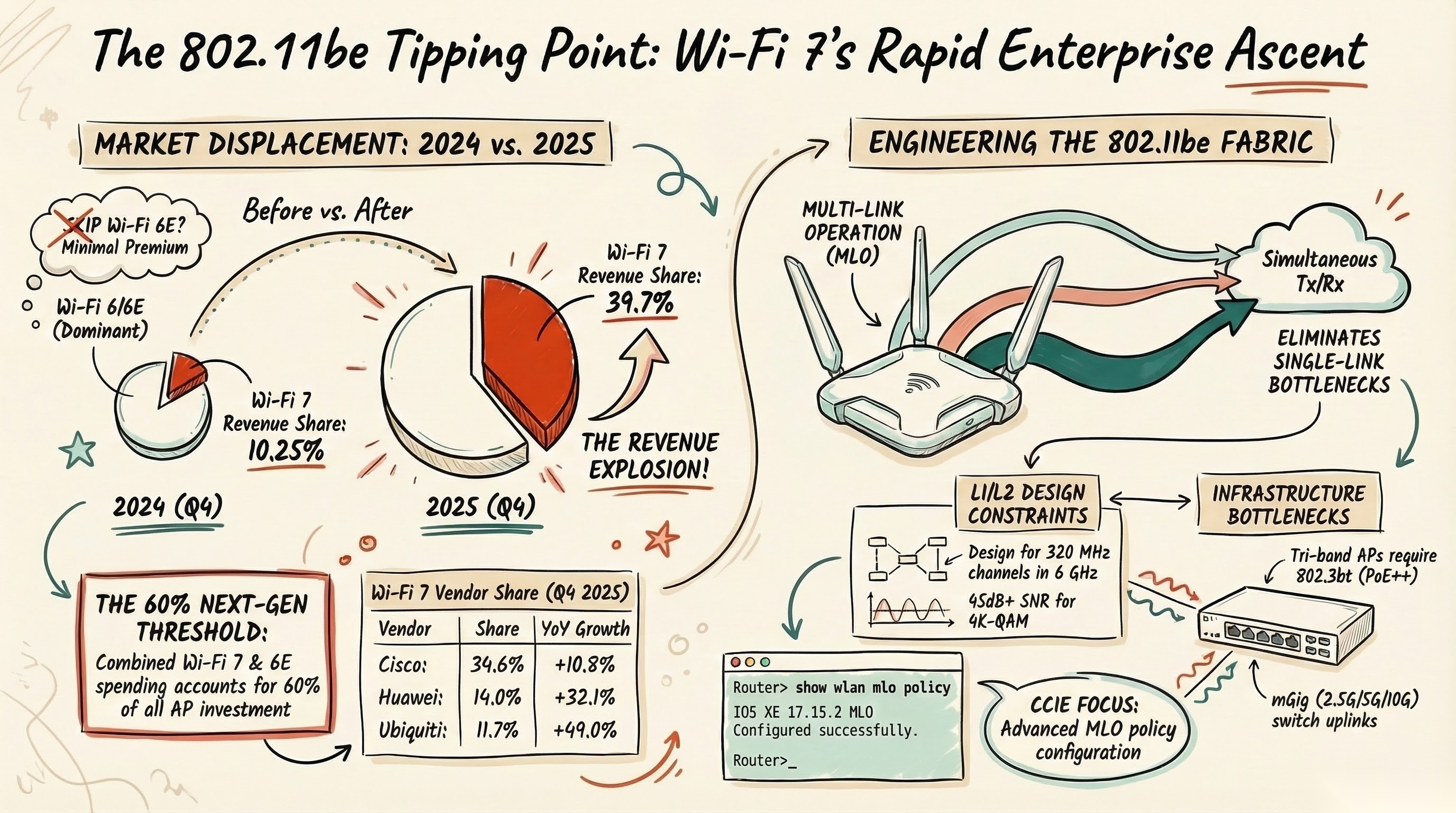
The year-over-year jump is staggering. In Q4 2024, Wi-Fi 7 represented just 10.25% of AP revenue. Twelve months later, it nearly quadrupled. According to Dell’Oro Group (January 2026), Wi-Fi 7 prices are “unusually low” compared to previous generation transitions, which is removing the typical cost barrier that slows enterprise adoption.
| Metric | Q4 2024 | Q4 2025 | Change |
|---|---|---|---|
| Wi-Fi 7 AP Revenue Share | 10.25% | 39.7% | +287% |
| Wi-Fi 6E AP Revenue Share | ~35% | 20% | Declining |
| Total Enterprise WLAN Revenue | ~$2.55B | $2.9B | +13.9% YoY |
| Full-Year Enterprise WLAN | $9.4B | $10.5B | +11.4% YoY |
Regional growth patterns reveal important disparities. According to IDC (Q4 2025), the Americas grew 13.9% year over year, EMEA surged 25.2%, while Asia Pacific declined 0.9%. EMEA’s outsized growth suggests aggressive European wireless modernization programs, likely tied to EU spectrum harmonization efforts for the 6 GHz band.
Which Vendors Are Winning the Wi-Fi 7 Enterprise Race?
Cisco maintained its dominant position in the enterprise WLAN market through Q4 2025, but the competitive landscape is shifting. According to IDC (March 2026), Cisco posted $1.0 billion in quarterly WLAN revenue, capturing 34.6% market share — up 10.8% year over year. For full-year 2025, Cisco generated $3.9 billion at 37.2% market share, though its annual growth of 4.9% lagged the overall market’s 11.4%.
The real disruption is happening below Cisco. Ubiquiti posted the highest growth among major vendors at 49.0% year over year, reaching $344.5 million in Q4 2025. For the full year, Ubiquiti’s revenue surged 53.1% to $1.2 billion, maintaining 11.7% market share. This growth is driven by aggressive Wi-Fi 7 pricing that appeals to mid-market and education verticals where Cisco’s premium positioning creates opportunity gaps.
| Vendor | Q4 2025 Revenue | Q4 2025 Share | YoY Growth | Full-Year 2025 Share |
|---|---|---|---|---|
| Cisco | $1.0B | 34.6% | +10.8% | 37.2% |
| HPE (incl. Juniper) | $552.8M | 18.8% | +4.7% | 19.7% |
| Huawei | $409.8M | 14.0% | +32.1% | 9.6% |
| Ubiquiti | $344.5M | 11.7% | +49.0% | 11.7% |
| CommScope (Ruckus) | $88.8M | 3.0% | +13.4% | 3.4% |
HPE’s acquisition of Juniper (completed July 2025) creates a combined entity with 18.8% market share and the Juniper Mist AI-driven wireless platform. According to Juniper’s March 2026 release notes, the Mist platform now supports full Wi-Fi 7 security configuration including GCMP-256 encryption and SAE-PK authentication — features that matter for enterprise environments requiring zero-trust wireless architectures.
Huawei’s 32.1% quarterly growth to $409.8 million reflects continued strength in EMEA and Asia Pacific markets where US-origin restrictions don’t apply. For network engineers working in multinational enterprises, understanding the Huawei wireless portfolio alongside Cisco and HPE/Juniper is increasingly important for global deployment planning.
What Makes Wi-Fi 7 Actually Different for Network Engineers?
Multi-Link Operation (MLO) is the feature that separates Wi-Fi 7 from every previous wireless generation. According to Cisco’s technical blog on MLO dissection (2025), MLO allows a client and access point to establish simultaneous connections across multiple frequency bands — 2.4 GHz, 5 GHz, and 6 GHz — at the same time. Every previous Wi-Fi standard forced clients to use a single radio link at any given moment, relying on band steering or roaming to shift between bands reactively.
The practical impact for enterprise networks is threefold. First, aggregate throughput increases because traffic flows across multiple links simultaneously. Second, latency drops because the lowest-latency link is always available for time-sensitive frames. Third, reliability improves because link failure on one band doesn’t interrupt the session — traffic seamlessly shifts to remaining links.
320 MHz Channels in 6 GHz
Wi-Fi 7 introduces 320 MHz channel widths in the 6 GHz band, doubling the maximum channel width from Wi-Fi 6E’s 160 MHz. According to Network Computing (2025), this wider channel capacity can reduce the number of access points needed in some deployments, simplifying network management in high-density environments. However, wider channels also mean fewer non-overlapping channels available — a critical RF design consideration that CCIE Enterprise Infrastructure candidates must understand.
In practice, 320 MHz channels work best in controlled environments with limited adjacent-cell interference: conference centers, auditoriums, and dedicated high-throughput zones. Most enterprise campus deployments will still use 80 MHz or 160 MHz channels for the 6 GHz radios to maintain channel reuse across the floor plan.
4K-QAM Modulation
Wi-Fi 7 upgrades from 1024-QAM (Wi-Fi 6/6E) to 4096-QAM, packing 20% more data into each symbol. The engineering caveat: 4K-QAM requires extremely high signal-to-noise ratios (SNR), typically above 45 dB. This means the benefit only materializes within approximately 3 meters of the access point — making it relevant for desk-adjacent deployments but negligible in typical open-office or warehouse scenarios.
Enterprise Hardware: What’s Shipping Now
The Wi-Fi 7 enterprise AP market is fully mature in 2026. Cisco’s Catalyst CW9178I is the flagship — a tri-radio, tri-band AP supporting MLO with IOS XE 17.15.2+ on the 9800 series wireless controllers. Pricing exceeds $2,000 per unit, positioning it for large enterprise and campus deployments.
Juniper’s AP47 offers tri-radio capability with 12 spatial streams, dual 10-Gigabit Ethernet uplink ports, and built-in Bluetooth/802.15.4 radios for IoT integration. The Mist AI platform provides real-time MLO analytics and automated channel optimization.
For network engineers evaluating Wi-Fi 7 APs, the uplink infrastructure is a critical — and often overlooked — planning factor. Tri-band APs operating MLO at full capacity can exceed 1 Gbps aggregate throughput, making mGig (2.5G/5G/10G) switch ports mandatory. Deploying Wi-Fi 7 APs on standard 1G uplinks creates an immediate bottleneck.
Why Are Enterprises Skipping Wi-Fi 6E for Wi-Fi 7?
The Wi-Fi 6E to Wi-Fi 7 transition is unlike any previous wireless generation jump because there’s almost no price premium to wait. According to Dell’Oro Group’s Siân Morgan, Research Director (January 2026), “Enterprise purchases of Wi-Fi 7 have shot up since early 2025. All major vendors have full portfolios of the new technology, and the price is unusually low.” Dell’Oro projects Wi-Fi 7 will be adopted by over 90% of the market, with revenue growth continuing for at least three more years.
Three factors are driving the accelerated skip:
Minimal price premium over Wi-Fi 6E. Unlike the Wi-Fi 5 to Wi-Fi 6 transition — where enterprise APs commanded a 30-40% premium — Wi-Fi 7 APs are priced only marginally above Wi-Fi 6E equivalents from most vendors.
MLO delivers immediate, measurable value. Previous generation transitions offered incremental throughput gains. MLO represents a fundamentally different architecture — multi-link aggregation — that reduces latency and improves reliability in ways enterprises can quantify from day one.
Future-proofing against AI workloads. As IDC analyst Brandon Butler noted (March 2026), “Enterprise WLAN is entering a new phase where it’s no longer just about connectivity — it’s about enabling AI-driven and digital business operations.” Real-time AI inference at the edge, video analytics, and IoT sensor aggregation all demand the low-latency, high-throughput characteristics that Wi-Fi 7 delivers natively.
The only risk to continued momentum is supply chain disruption. Dell’Oro Group warns that component shortages driven by the AI infrastructure boom are creating “volatile lead times” on some WLAN products. If silicon allocation shifts further toward GPU and AI accelerator production, Wi-Fi 7 pricing could increase and order backlogs could grow — echoing the post-pandemic supply chain upheaval of 2021-2022.
How Should Network Engineers Plan Wi-Fi 7 Deployments?
Successful Wi-Fi 7 enterprise deployment requires more than swapping access points. According to BizTech Magazine (October 2025), the larger and more distributed the network, the more strategic a Wi-Fi 7 rollout must be. Enterprises should begin deployment in high-density or mission-critical zones — collaboration hubs, manufacturing floors, and customer-facing retail spaces — where performance and capacity gains deliver the highest ROI.
Phase 1: RF Assessment and 6 GHz Planning
Before any hardware purchase, conduct a comprehensive RF site survey that includes 6 GHz propagation characteristics. The 6 GHz band has shorter range and higher attenuation through walls compared to 5 GHz, which directly impacts AP placement density. Tools like Ekahau AI Pro and Hamina now include Wi-Fi 7 channel planning modules that model MLO behavior across tri-band configurations.
Phase 2: Infrastructure Readiness
Verify the switching infrastructure can support mGig uplinks. A Cisco Catalyst 9300 with C9300-NM-8X module provides 10G ports for Wi-Fi 7 APs, while the Catalyst 9400 series supports mGig across high-density line cards. PoE budgets also increase with tri-radio APs — plan for 802.3bt (PoE++) at 60W or higher per port.
Phase 3: Controller and Policy Configuration
For Cisco environments, the Catalyst 9800 series wireless controller running IOS XE 17.15.2 or later fully supports Wi-Fi 7 MLO configuration. Key CLI elements include:
wireless profile policy wifi7-policy
  mlo enable
  mlo peer-link band 5ghz 6ghz
  traffic-distribution load-balance
Define MLO peer-link bands based on the deployment zone. High-throughput zones benefit from 5 GHz + 6 GHz MLO pairs, while coverage-priority zones may use 2.4 GHz + 5 GHz combinations for range extension.
Phase 4: Client Compatibility Validation
Not all enterprise clients support MLO in 2026. According to Microsoft’s Windows IT Pro blog (2025), Wi-Fi 7 enterprise connectivity on Windows requires collaboration across silicon vendors, AP manufacturers, and OS drivers. Validate your client device fleet — laptops, tablets, VoIP phones, and IoT devices — against MLO compatibility matrices before enabling MLO policies network-wide. Legacy Wi-Fi 6/6E clients will continue to associate normally but won’t benefit from multi-link aggregation.
What Does This Mean for CCIE Enterprise Infrastructure Candidates?
The Wi-Fi 7 market data confirms what CCIE lab candidates have been anticipating: wireless design is no longer a secondary topic. With 60% of enterprise WLAN dollars flowing to Wi-Fi 6E and Wi-Fi 7 in Q4 2025, the CCIE Enterprise Infrastructure exam’s wireless sections carry increasing practical relevance.
Specific skill areas to prioritize:
- MLO policy design — Understanding when to enable MLO, which band combinations to pair, and how MLO interacts with roaming policies across a campus fabric
- 6 GHz RF planning — Channel width selection (80/160/320 MHz), DFS avoidance in 5 GHz, and 6 GHz-specific propagation modeling for walls and floors
- mGig uplink design — Matching switch infrastructure capacity to Wi-Fi 7 AP throughput requirements
- Security policy for Wi-Fi 7 — WPA3-Enterprise with GCMP-256, SAE-PK for IoT devices, and integration with ISE-based zero trust frameworks
- AI-driven wireless operations — Cisco DNA Center and Juniper Mist AI capabilities for automated channel optimization, anomaly detection, and predictive capacity planning
The enterprise network spending trends in 2026 confirm that wireless infrastructure investment is outpacing wired switching growth for the first time. Engineers who position themselves at this intersection — wireless design expertise backed by CCIE-level understanding of the underlying VXLAN/EVPN fabric that connects it all — will command premium compensation.
What Risks Could Slow Wi-Fi 7 Momentum?
Three factors could temper Wi-Fi 7’s growth trajectory through the remainder of 2026. First, Dell’Oro Group warns that AI-driven component shortages are creating supply chain volatility. “Lead times on some WLAN products are volatile right now,” said Siân Morgan of Dell’Oro Group (January 2026). “If vendors can win the game of component-shortage whack-a-mole then we expect healthy market growth. Otherwise, we may see prices increase and order backlogs grow.”
Second, the Asia Pacific market declined 0.9% year over year in Q4 2025, according to IDC. Regional disparities in 6 GHz spectrum allocation — particularly in countries where regulatory approval for full 6 GHz WLAN use remains pending — create uneven adoption patterns that affect multinational deployment planning.
Third, Wi-Fi 8 (802.11bn) is already generating industry attention. According to Dell’Oro Group (January 2026), revenue expectations for Wi-Fi 8 have increased for 2028, which could cause some enterprises to delay large-scale Wi-Fi 7 refreshes in anticipation of the next standard. However, with Wi-Fi 7 peaking around 2029 per Dell’Oro’s forecast, there’s a solid 3-4 year deployment window before Wi-Fi 8 reaches enterprise maturity.
For network engineers, the pragmatic approach is clear: deploy Wi-Fi 7 now for high-density and mission-critical zones, plan refresh cycles around 5-7 year AP lifespans, and monitor Wi-Fi 8 developments without letting them paralyze current investment decisions.
Frequently Asked Questions
How much enterprise WLAN revenue does Wi-Fi 7 represent in 2026?
According to IDC’s Q4 2025 WLAN Tracker (published March 2026), Wi-Fi 7 captured 39.7% of dependent access point segment revenue, up from 10.25% one year earlier. Combined with Wi-Fi 6E at 20%, next-generation wireless standards now account for 60% of total enterprise AP spending worldwide. The full-year 2025 enterprise WLAN market reached $10.5 billion.
Is Wi-Fi 7 replacing Wi-Fi 6E in enterprise deployments?
Yes — the market data shows a clear leapfrog pattern. Wi-Fi 6E’s share of AP revenue dropped from approximately 35% to 20% as enterprises moved directly to Wi-Fi 7. According to Dell’Oro Group (January 2026), Wi-Fi 7 prices are “unusually low” compared to previous generation transitions, which removes the cost barrier that typically slows adoption. Dell’Oro projects over 90% market adoption of Wi-Fi 7.
What is Multi-Link Operation (MLO) and why does it matter?
MLO is the defining feature of 802.11be (Wi-Fi 7). According to Cisco’s technical deep-dive, it allows a client device and access point to establish simultaneous connections across multiple frequency bands. This eliminates the single-link bottleneck of all previous Wi-Fi generations. The practical result: higher aggregate throughput, lower latency (because the fastest available link is always used), and improved reliability (because a link failure on one band doesn’t interrupt the session). For CCIE Enterprise Infrastructure candidates, MLO policy design is becoming a must-know skill.
Which enterprise WLAN vendor is growing fastest?
Ubiquiti posted the highest growth at 49.0% year over year in Q4 2025, according to IDC, reaching $344.5 million in quarterly revenue. For the full year, Ubiquiti grew 53.1%. However, Cisco remains the clear market leader at 34.6% share ($1.0 billion quarterly), and the HPE-Juniper combination at 18.8% creates a formidable second-place competitor with the Mist AI wireless platform.
Should I deploy Wi-Fi 7 now or wait for Wi-Fi 8?
Deploy Wi-Fi 7 now for high-density and mission-critical zones. According to Dell’Oro Group, Wi-Fi 7 adoption will peak around 2029, giving enterprises a 3-4 year runway before Wi-Fi 8 (802.11bn) reaches mainstream enterprise deployment. Wi-Fi 8 revenue expectations have increased for 2028, but enterprise-grade maturity won’t arrive until 2029-2030 at the earliest.
Want help planning your practice? Talk to FirstPassLab on Telegram.