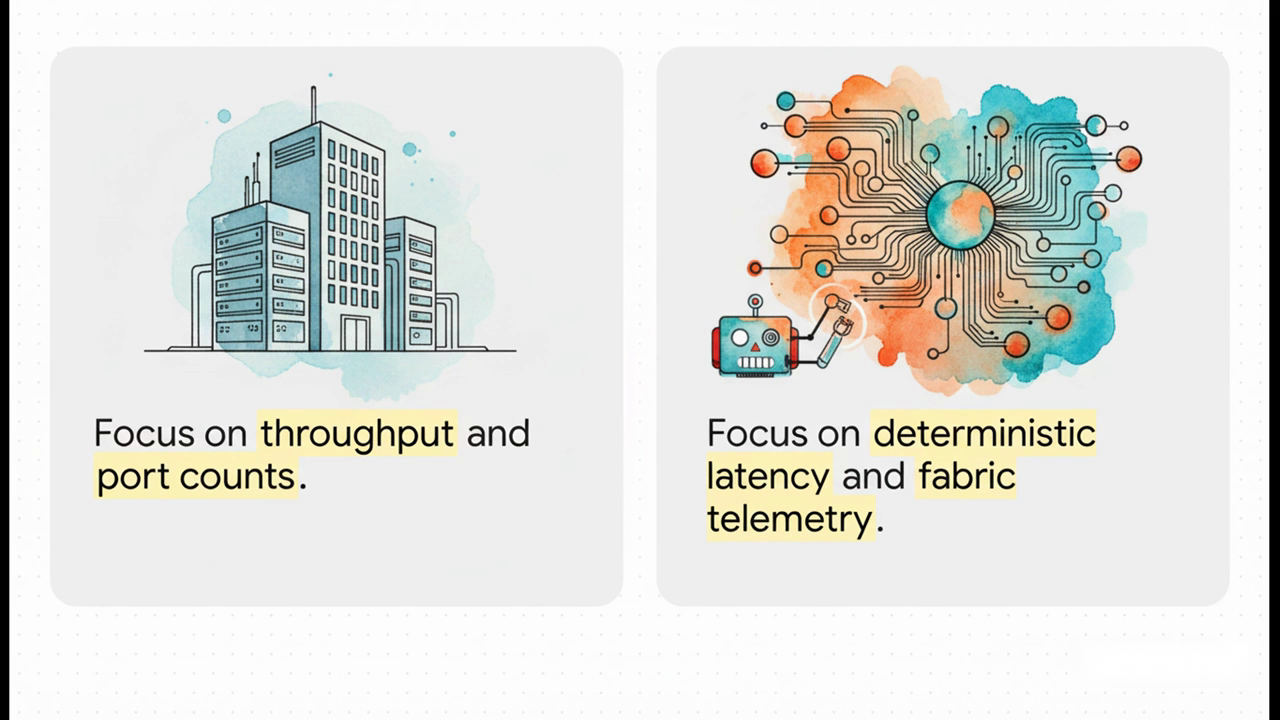
Oracle’s layoffs matter to network engineers because they show exactly where hyperscaler money is moving: away from headcount and toward AI data center capacity built on ultra-low-latency GPU fabrics. According to CNBC (2026), Oracle is cutting thousands of jobs while TD Cowen estimated the move could free $8 billion to $10 billion in cash flow, and according to Oracle (2026), OCI Supercluster is now positioned for up to 131,072 GPUs with cluster latency as low as 2.5 microseconds using RoCEv2-based networking.
Key Takeaway: Oracle’s restructuring is not just a workforce story. It is a signal that AI-era value is now created or destroyed in the network fabric, especially in RoCEv2 congestion control, optics, and large-cluster operations.
What happened at Oracle, and why are network engineers paying attention?
Oracle’s layoffs matter because they reveal a capital-allocation choice that directly favors AI infrastructure over broader organizational spend. According to CNBC (2026), Oracle is conducting layoffs in the thousands, and TD Cowen estimated that cutting 20,000 to 30,000 employees could create $8 billion to $10 billion in incremental cash flow. According to CIO (2026), industry reporting tied the broader restructuring to a reported AI data center expansion plan sized at roughly $156 billion. For network engineers, the key point is not the HR headline. It is that hyperscalers and cloud providers are now willing to reorganize entire cost structures to fund GPU clusters, dense east-west fabrics, and AI-ready facilities. When a company this large reallocates at that scale, the network stops being background infrastructure and becomes part of the board-level growth strategy.
| Reported signal | What sources said | Why network engineers should care |
|---|---|---|
| Workforce cuts | According to CNBC (2026), Oracle is laying off thousands of employees | Cash is being redirected toward infrastructure, not general IT expansion |
| Cash flow impact | According to CNBC (2026), TD Cowen estimated $8 billion to $10 billion in additional cash flow | That is enough to influence how aggressively Oracle expands AI regions and cluster capacity |
| Buildout scope | According to CIO (2026), reports tied the move to a roughly $156 billion AI data center push | The network fabric behind those data centers becomes a strategic asset, not a procurement line item |
| Cloud target | According to Oracle (2026), OCI Supercluster scales to 131,072 GPUs today and larger zettascale designs beyond that | The farther clusters scale, the more design risk shifts into latency, queueing, optics, and fault domains |
Why does an AI data center spending story quickly become a networking story?
An AI data center spending story becomes a networking story almost immediately because frontier AI clusters fail on data movement before they fail on raw compute procurement. According to Oracle (2026), OCI’s AI infrastructure supports up to 3,200 Gb/sec of cluster network bandwidth, up to 400 Gb/sec of front-end network bandwidth, and 2.5 to 9.1 microseconds of cluster latency using custom-designed RoCEv2 networking. According to Oracle’s GTC 2026 infrastructure update (2026), the company’s Acceleron architecture combines RoCE, CNIC offload, and a multiplanar network design to deliver predictable communication across large AI clusters. That means the real engineering challenge is not simply installing more GPUs. It is keeping collective operations, checkpointing, storage access, and inference fan-out from collapsing under congestion, retransmissions, or poor fabric design.
For classic enterprise teams, it helps to split the problem into two planes. The front-end network carries client traffic, APIs, and storage access. The back-end cluster network carries the GPU-to-GPU and node-to-node exchanges that determine training efficiency. In AI environments, the back-end network is no longer “just fast Ethernet.” If latency spreads or queues explode, expensive accelerators sit idle. For more background, see our NVIDIA Spectrum-X Ethernet AI fabric deep dive and our RoCE vs InfiniBand guide for AI data centers.
What does OCI’s AI fabric actually look like?
OCI’s AI fabric looks like a purpose-built GPU cluster network where bandwidth, latency, and failure isolation are engineered together rather than purchased in separate silos. According to Oracle (2026), OCI Supercluster can scale to 131,072 GPUs and uses high-speed RDMA over Converged Ethernet version 2 with NVIDIA ConnectX NICs. According to Oracle’s infrastructure material (2026), the platform targets 2.5 to 9.1 microseconds of cluster latency and up to 3,200 Gb/sec of cluster bandwidth. Oracle’s GTC 2026 update (2026) adds a second important detail: the company is standardizing around an Acceleron design that combines RoCE, CNIC offload, and multiplanar networking so the cluster behaves consistently at large scale. In plain English, Oracle is telling architects that AI economics depend on fabric behavior as much as GPU count.
| Fabric element | Oracle claim or design detail | Operational implication |
|---|---|---|
| Cluster scale | According to Oracle (2026), OCI Supercluster supports up to 131,072 GPUs | Oversubscription and fault-domain design become architectural decisions, not cabling details |
| Back-end transport | According to Oracle (2026), the cluster network uses RoCEv2 | Engineers must understand queue behavior, ECN marking, and pause-domain design |
| Host edge | According to Oracle (2026), NVIDIA ConnectX NICs are part of the design | NIC tuning, telemetry, and congestion signaling matter at the server edge |
| Network design | According to Oracle (2026), Acceleron uses CNIC offload and multiplanar networking | Service separation and path diversity become performance tools |
| Front-end network | According to Oracle (2026), OCI offers up to 400 Gb/sec of front-end bandwidth | Storage, ingress, and user-facing traffic still need clean isolation from cluster hot paths |
There is also a useful protocol lesson here. RoCEv2 runs over IP and Ethernet, which means the fabric only behaves well when congestion is managed intentionally. PFC can suppress drops for a class of traffic, but poor design can spread pain across the fabric. ECN can mark pressure before the network falls apart, but only if queues, thresholds, and telemetry are tuned correctly. That is why AI networking rewards engineers who think in packet paths and failure domains, not just port counts.
Which Cisco and CCIE Data Center skills become more valuable because of this?
Cisco and CCIE Data Center skills become more valuable when they map to the specific failure modes of AI fabrics, and Oracle’s move makes that mapping much easier to see. According to Oracle (2026), OCI is betting on RoCEv2, high-speed cluster bandwidth, and large-scale GPU fabrics. That translates directly into skills around loss-aware Ethernet design, optical planning, QoS policy boundaries, host-edge telemetry, and fabric troubleshooting under sustained east-west pressure. The engineers who win in this market will not be the ones who only know how to deploy another leaf-spine fabric. They will be the ones who can explain how a microburst affects collective operations, why pause-domain blast radius matters, and how to separate front-end user traffic from back-end accelerator flows.
A practical study list looks like this:
- Master RoCEv2 behavior. Understand how ECN, PFC, and congestion notification interact in large clusters.
- Treat optics as part of the architecture. AI clusters expose insertion loss, power, and thermal limits faster than ordinary enterprise pods.
- Get better at telemetry. Queue depth, latency variation, retransmissions, and NIC counters matter more than average interface utilization.
- Study DPU and NIC offload models. CNICs, DPUs, and host-edge acceleration increasingly shape policy and performance.
- Keep your EVPN and fabric fundamentals sharp. The control plane still matters even when the workload is AI-heavy.
If you want a tighter study cluster, pair this article with our CCIE Data Center track page, our analysis of Equinix Distributed AI Hub and DCI architecture, our look at Microsoft MOSAIC and optical power savings, and our earlier piece on Marvell’s AI data center revenue surge. Those four together explain why data center networking is moving closer to semiconductor and optics strategy every month.
Why does Oracle’s move matter beyond Oracle?
Oracle’s move matters beyond Oracle because it confirms that the AI infrastructure race is now a fabric race, not just a compute race. According to Oracle (2026), its Zettascale10 direction spans multiple data centers and is intended to integrate as many as 800,000 NVIDIA GPUs through ultra-low-latency InfiniBand and RoCE-based networks. According to Cisco and NVIDIA (2026), validated AI factory designs are also expanding across Cisco Silicon One, Spectrum-X-based switches, BlueField DPUs, and security controls embedded closer to the server and cluster edge. Taken together, those announcements show that vendors are competing on integration discipline, not just on chip benchmarks. Whoever makes the network predictable at enormous scale will capture the most valuable AI workloads.

Most mainstream coverage stops at the human cost or the stock-market angle, but it misses the architecture point. Oracle’s layoffs only make strategic sense if the company believes its AI networking model and GPU cluster design can produce higher returns than the areas it is trimming. That is why this story belongs next to our coverage of NVIDIA’s GTC 2026 networking roadmap, Meta’s Spectrum-X Ethernet buildout, and the broader shift from traditional data centers to AI factories.
What should network engineers do in the next 90 days?
Network engineers should use the next 90 days to reposition from general data center operations toward AI fabric literacy. Audit your understanding of RoCEv2 and the tradeoffs between throughput, determinism, and congestion containment. Revisit optical assumptions around dense 400G and 800G designs, then translate those ideas into business language such as GPU utilization and training-job completion time.
Here is a concrete checklist:
- Review one RoCEv2 design this week. Focus on congestion behavior, not just topology diagrams.
- Map front-end and back-end traffic separately. If your current diagrams collapse them into one blob, fix that.
- Add queue and latency telemetry to your study plan. AI fabrics punish teams that only watch throughput graphs.
- Follow vendor AI reference architectures closely. Oracle, Cisco, and NVIDIA are effectively publishing the next generation of data center job requirements.
- Tie every new topic back to certification value. The more AI clusters look like production networks, the more CCIE Data Center skills compound.
Frequently Asked Questions
Why do Oracle’s layoffs matter to network engineers?
Because they underline a capital shift toward AI infrastructure, where cluster latency, east-west bandwidth, and GPU fabric design now drive business outcomes.
What networking stack powers OCI Supercluster?
According to Oracle (2026), OCI Supercluster uses RoCEv2, NVIDIA ConnectX NICs, and high-bandwidth cluster networking. Oracle’s newer Acceleron design adds RoCE, CNIC offload, and multiplanar networking to improve predictability at scale.
Is this mainly a cloud finance story or a technical networking story?
It is both, but the technical lesson is stronger for engineers. If the fabric cannot deliver deterministic latency and congestion control, the compute investment does not pay back cleanly.
What should CCIE Data Center candidates study next?
Study RoCEv2 behavior, ECN and PFC tradeoffs, optics, telemetry, and DPU-aware operations. Those are the skills that keep appearing underneath real AI infrastructure announcements.
Ready to fast-track your CCIE journey? Contact us on Telegram @firstpasslab for a free assessment.