Frontier AI does not make established security architecture obsolete; it makes the assumptions underneath it expire faster. Vulnerability discovery can now run at a scale that remediation teams, change windows, and asset owners were not designed to match. Senior network engineers should keep controls such as segmentation, least privilege, secure management planes, and behavioral detection, but revalidate their coverage against a faster adversary and treat containment as a primary design requirement.
Key Takeaway: The practical frontier AI security problem is not a missing framework. It is a widening gap between machine-speed discovery and human-governed remediation.
What changed in frontier AI security?
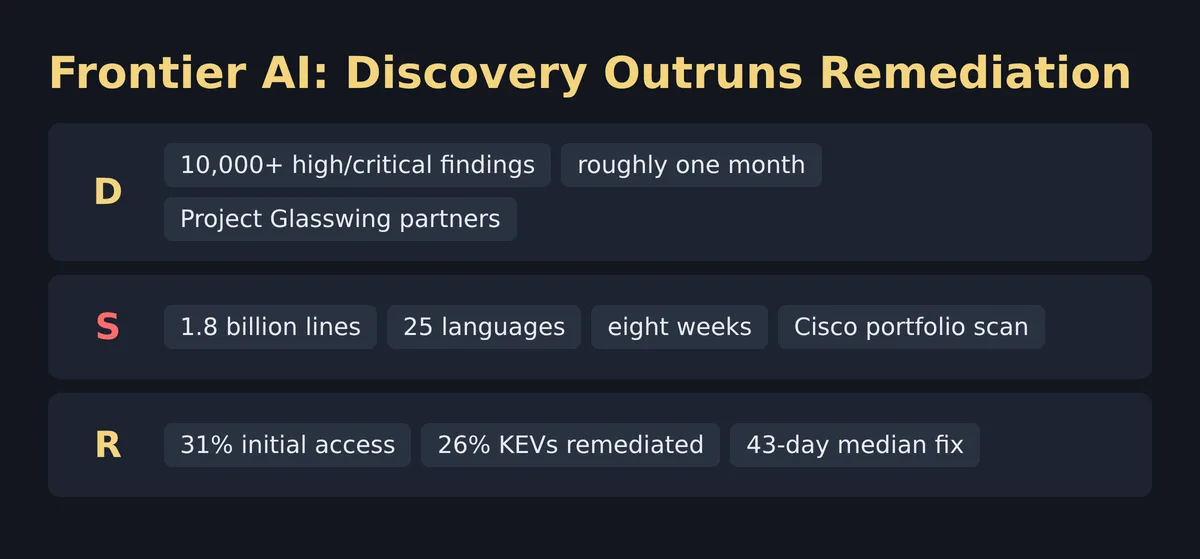
Frontier AI changed the rate at which security teams can inspect code and produce actionable findings, not the basic physics of compromise. According to Cisco Blogs (2026), Project Glasswing partners found more than 10,000 high- or critical-severity vulnerabilities in roughly one month, while some teams increased their finding rate by more than tenfold. Cisco also reported scanning 1.8 billion lines of code across 25 languages in eight weeks with a false-positive rate below 3%. Those figures matter because the constraint shifts downstream: triage, ownership, patch development, regression testing, deployment, and verification now determine exposure. A threat model that assumes discovery is scarce will misallocate engineering effort. For network teams, the immediate question is no longer whether a scanner can identify another weakness. It is whether routing, identity, segmentation, telemetry, and operational processes prevent that weakness from becoming a reliable path to a high-value system.

Cisco’s comparison is stark. According to Cisco Blogs (2026), the same portfolio scan would have taken roughly eight years using the previous approach. The Government of Alberta example in the same source covered 466 million lines across 27 ministries in about 20 hours. These are vendor-reported results rather than a universal benchmark, but they are enough to invalidate a comfortable assumption: discovery throughput will not stay aligned with conventional remediation capacity.
| Old planning assumption | Frontier-AI reality | Architecture response |
|---|---|---|
| Findings arrive near human review speed | Discovery can exceed triage capacity | Rank by reachable attack path and business impact |
| Skill limits constrain broad code review | Models can distribute analysis across large estates | Protect source, build, and model access as privileged systems |
| A periodic threat model remains current | Capabilities and misuse patterns change between reviews | Trigger reviews from capability and incident evidence |
| Prevention failure is exceptional | Some findings will outlive the safe patch window | Engineer segmentation, isolation, and recovery before disclosure |
This is not an argument for accepting scanner output uncritically. A low reported false-positive rate does not remove the need to reproduce findings, establish exploitability, and identify the affected deployment path. It argues for better decision machinery around the findings.
Which threat-model assumptions now need explicit revalidation?
Security teams should revalidate attacker prerequisites, time-to-action, reachable assets, identity boundaries, and recovery dependencies whenever frontier-model capability or access changes materially. The Frontier Model Forum describes threat modeling as a process that maps actors, harmful outcomes, attack pathways, assumptions, and variables; it also says those models require continuous updates as capabilities and real-world misuse evolve. That guidance preserves useful structures such as MITRE ATT&CK, the Cyber Kill Chain, and STRIDE while rejecting static inputs. For a senior network engineer, the highest-value exercise is to select a critical service and challenge every latency assumption in its attack path. How long before a disclosed defect becomes operational knowledge? Which control sees reconnaissance? Which identity can cross the management boundary? What limits east-west movement? What evidence proves isolation worked? The framework remains recognizable, but the answers need to survive a faster and more persistent adversary.
I would put five assumptions on the review board:
- Recalculate attacker prerequisites. Do not carry forward a skill rating merely because an exploit chain once required specialist knowledge. Document which steps still require privileged access, nonpublic context, or environmental knowledge.
- Reassess time-to-exploitation. Use observed internal and threat-intelligence data rather than a fixed grace period. If the organization lacks reliable evidence, label the interval unknown and design the compensating control accordingly.
- Trace identity separately from reachability. A denied TCP path does not neutralize a stolen token, overprivileged service principal, or trusted automation runner. Map both network and authorization edges.
- Test containment against the real dependency graph. Include DNS, identity providers, orchestration systems, management interfaces, logging pipelines, and backup control planes.
- Define closure evidence. A deployed patch is an activity; a failed exploit replay, clean exposure scan, and restored policy compliance are evidence.
This process complements the CCIE Security lab preparation guide because expert-level design is still about explaining why boundaries exist and how failure is contained. It also extends the operational lessons in the Cisco FMC zero-day response guide, where management-plane isolation matters independently of the vulnerability mechanism.
Why is remediation now the limiting control?
Remediation is the limiting control because finding a defect is only the first state transition in a production change. According to Cisco Blogs (2026), the Verizon Data Breach Investigations Report cited vulnerability exploitation as the leading initial-access vector at 31%, while only 26% of vulnerabilities in CISA’s Known Exploited Vulnerabilities catalog were fully remediated and the median fix time reached 43 days. Those figures describe an execution gap, not a detection gap. A patch can remain unsafe to deploy until an owner validates compatibility, a network team confirms redundancy, a service team schedules disruption, and security verifies the result. Frontier AI increases pressure at the front of that queue without automatically increasing safe change capacity at the back. The right response is not a raw patch-count target. It is a remediation system that prioritizes exploitable paths, assigns explicit ownership, uses temporary containment, and measures verified risk retirement.
| Queue signal | Weak interpretation | Better operational decision |
|---|---|---|
| Severity score | Patch every critical item first | Combine severity with exposure, reachability, and asset value |
| Scanner finding count | Treat volume as progress | Track validated, owned, mitigated, and verified states |
| Patch deployed | Close the ticket | Retest the path and confirm telemetry remains healthy |
| Exception approved | Accept permanent exposure | Set an expiry, compensating control, and accountable owner |
The network team has direct control over part of this backlog. An ACL, SGT policy, VRF boundary, proxy rule, or management-plane filter can reduce reachability while a software owner prepares the durable fix. Those controls should be treated as time-bounded risk reduction, not substitutes for correction. Engineers also need to protect remediation infrastructure itself: software repositories, CI runners, automation credentials, configuration archives, and out-of-band access form a privileged chain.
For a concrete example of identity and policy containment, the Forescout identity-segmentation analysis explains why dynamic identity context can outperform coarse location-based boundaries. The managed SASE and universal ZTNA review provides a complementary model for enforcing policy across users, applications, and locations.
How should network architecture change when prevention cannot keep pace?
Network architecture should assume that at least one exploitable weakness will remain open and make that weakness hard to convert into material impact. Cisco’s recommendation is to assume breach, use layered defense, map controls to MITRE ATT&CK, and improve detection and response speed. I agree with that direction, but the implementation needs verifiable failure domains rather than a generic collection of security products. Separate user, workload, management, build, model, and recovery planes; minimize transitive trust between them; and record the policy decision at each crossing. Then test what happens when one identity, workload, or administrative endpoint is compromised. The goal is not to claim perfect prevention. It is to make lateral movement visible, deny access to the next valuable dependency, preserve trustworthy telemetry, and keep a recovery channel outside the affected trust domain. That is standard resilient-network engineering applied with less tolerance for stale assumptions.
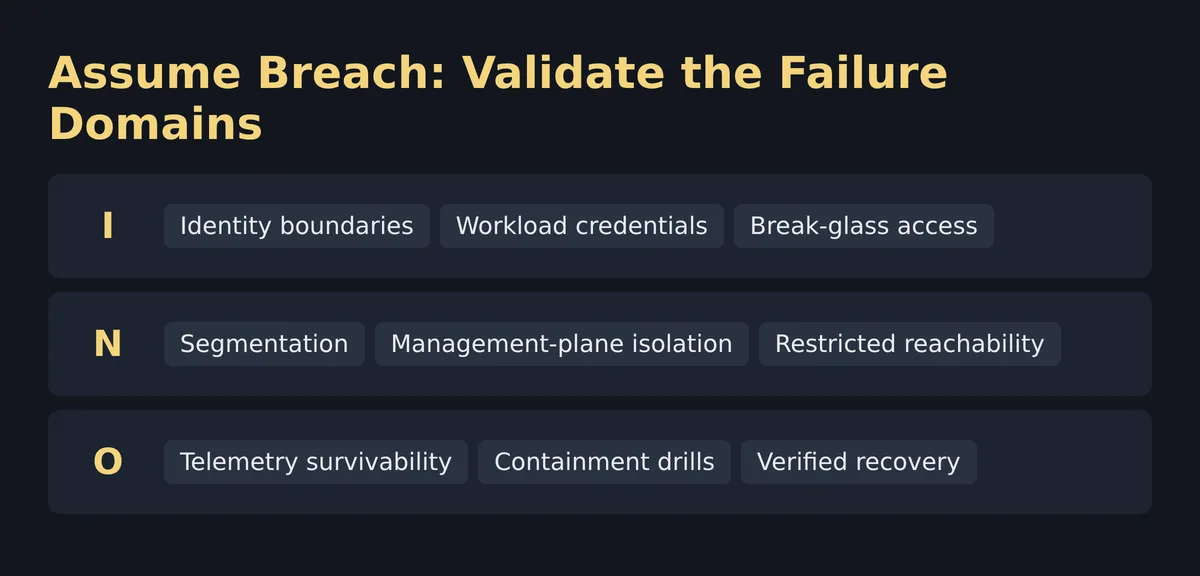
My preferred validation sequence is simple:
- Select a crown-jewel service. Include its user path, application dependencies, administrative interfaces, and recovery systems.
- Compromise one assumed control. Model a stolen workload identity, exposed management service, vulnerable API, or poisoned automation artifact.
- Observe every boundary. Confirm enforcement and logs at identity, routing, firewall, proxy, DNS, and workload layers.
- Isolate without destroying evidence. Exercise quarantine paths, credential revocation, route withdrawal, and restricted administrative access.
- Recover from a separate trust domain. Validate backups, clean configuration sources, break-glass identity, and out-of-band reachability.
- Feed evidence back into design. Update the threat model, exception register, detection content, and remediation priority.
This approach is consistent with zero-trust principles but avoids turning zero trust into a product label. The architectural work is in explicit policy enforcement and measured blast radius. The AWS Bedrock DNS-exfiltration analysis is a useful reminder that a system described as sandboxed can still retain a protocol path that matters. The right question is always what the workload can actually reach and authorize, not what its environment is called.
What does frontier AI mean for CCIE-level practice?
Frontier AI raises the value of CCIE-level reasoning because the hard problem remains the interaction between protocols, trust, failure, and operations. The Canadian Centre for Cyber Security advises organizations to assess how frontier AI affects their threat exposure and to strengthen security practices as the technology evolves. For expert network engineers, that means threat models cannot live only in governance documents. They must resolve into enforcement points, observable flows, identity decisions, rollback plans, and failure tests. A candidate who can configure a control but cannot explain its bypass path has not completed the design. A production engineer who can identify thousands of weaknesses but cannot rank reachable risk has not improved resilience. AI can increase analytical throughput, but accountability for topology, policy, operational safety, and evidence remains with the engineering team. The durable skill is converting a changing threat into a defensible architecture and a sequence of safe changes.
For study, treat AI-assisted discovery as an input to familiar design domains:
- Map adversary actions to MITRE ATT&CK, then name the network and identity telemetry that would confirm each action.
- Compare policy intent with the actual forwarding and authorization path.
- Design management-plane access so production compromise does not imply control-plane compromise.
- Rehearse containment and recovery under partial observability.
- Require source attribution and reproducibility from AI-generated findings before changing production.
The broader CCIE Security learning path remains the relevant cornerstone: deep protocol knowledge, identity, segmentation, VPNs, secure management, and operational troubleshooting are the controls that turn a threat model into a working system. Frontier AI changes their urgency and review cadence, not their foundational value.
Frequently Asked Questions
Frontier AI security questions usually reduce to four operational decisions: what changed in attacker capability, which framework assumptions expired, where containment occurs, and what evidence closes risk. The answers below keep established security models intact while making their review cycle responsive to capability and incident evidence. They also distinguish vulnerability discovery from remediation, because a larger findings queue is not equivalent to lower exposure. For network teams, the practical center of gravity is enforcement: identity boundaries, reachability, management-plane isolation, telemetry survivability, and recovery access. Those are the places where architectural intent becomes observable behavior. A model can help enumerate paths and test hypotheses, but engineers still need to validate output against the deployed environment and primary sources. Treat every AI-generated conclusion as a lead until it is reproduced, scoped, assigned, and verified through the same evidence discipline used for any other security finding.
How does frontier AI change a network security threat model?
It changes the assumed speed, scale, and skill required for vulnerability discovery and exploitation. Keep established frameworks, but reassess attacker capability, control latency, blast radius, and the evidence used to declare remediation complete.
Should network engineers replace MITRE ATT&CK for frontier AI threats?
No. MITRE ATT&CK remains useful for mapping adversary behavior, but the assumptions attached to techniques need more frequent review as AI changes the cost and speed of offensive work.
What should security teams prioritize first for frontier AI risk?
Prioritize an accurate exposure inventory, risk-based remediation queues, segmentation around high-value systems, and telemetry that proves whether controls contain a realistic attack path.
Can AI vulnerability discovery solve the remediation backlog?
Discovery alone cannot solve it. Teams still need ownership, safe patch validation, maintenance windows, compensating controls, and evidence that a fix closed the exploitable path.
Want help planning your practice? Talk to FirstPassLab on Telegram.