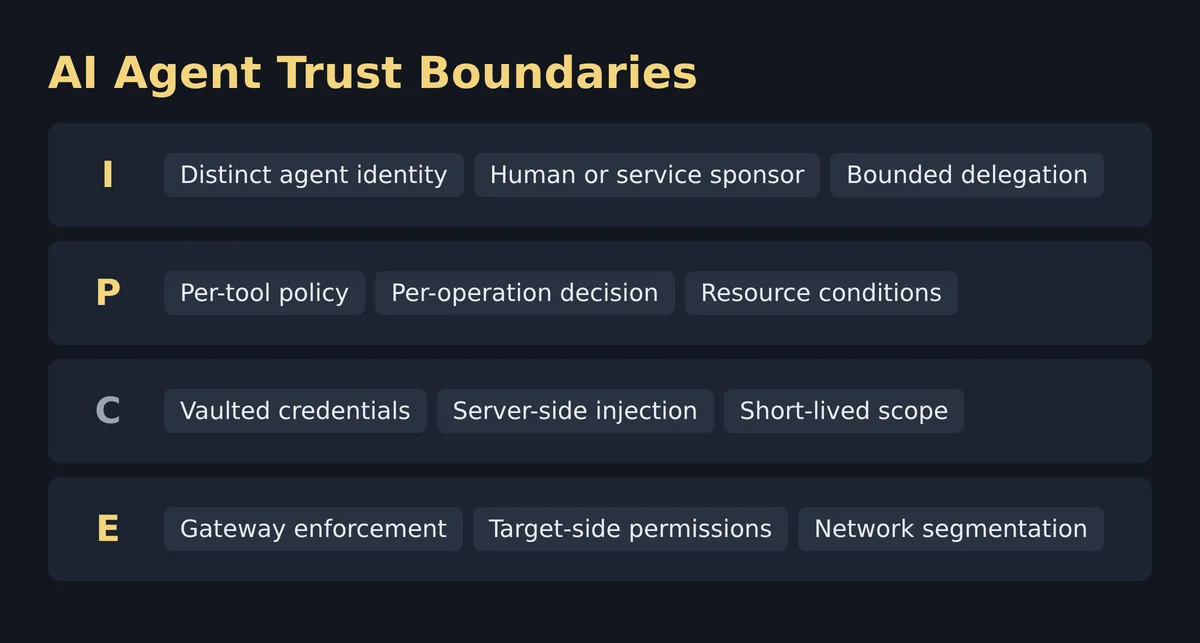
Your AI agent trusts whatever its runtime, tools, credentials, network path, and delegated identities allow it to reach—even when nobody approved the resulting action. Restore control by giving the agent its own identity, enforcing authorization outside the model, issuing narrowly scoped credentials, filtering every tool call, segmenting reachable systems, and logging each decision. The agent can propose an action; infrastructure must decide whether it runs.
Key Takeaway: Treat an agent as an untrusted non-human workload whose authority is computed per action, never inherited wholesale from its user, host, tool server, or prompt.
This is independent technical analysis and is not affiliated with or endorsed by Cisco, NIST, or any AI platform vendor.
What trust boundaries does an AI agent cross?
An AI agent crosses a trust boundary whenever it accepts instructions, retrieves context, selects a tool, receives a credential, calls a service, delegates work, or writes a result. According to NIST (2026), an agentic architecture can dynamically acquire context, process it, take action, and return a response; that sequence creates separate identity and authorization questions at every transition. Cisco Blogs (2026) adds the supply-chain concern: an agent skill can appear to be documentation while carrying instructions that execute with the agent’s file access, credentials, and network reach. The useful engineering model is therefore not one box labeled “AI.” It is a chain of independently controlled principals and resources. Inventory the agent, orchestrator, model endpoint, prompt sources, retrieval stores, skills, Model Context Protocol servers, APIs, credentials, target systems, and human sponsor. Then identify exactly where data and authority cross between them.

| Boundary | Hidden trust often inherited | Control that should make it explicit |
|---|---|---|
| User to agent | The user’s entire role or active session | Delegated, task-specific authority with an owner |
| Prompt or document to planner | Retrieved text is treated as instruction | Content provenance, instruction/data separation, input policy |
| Agent to skill | Installed metadata is assumed safe | Signed provenance, review status, version pinning, allowlist |
| Agent to MCP server | Server access implies every tool is acceptable | Per-tool and per-operation authorization |
| Runtime to credential | Possession is treated as permission | Vaulted secret and server-side injection after policy approval |
| Gateway to target | Gateway approval is treated as sufficient | Native API, database, repository, and network enforcement |
| Parent to child agent | Delegation silently expands authority | Bounded delegation with traceable parent and purpose |
Cisco’s article closes a gap that many general agent-security explainers leave open: dependency review must include the behavioral meaning of a skill, not just conventional malware signatures. A package hash can prove which artifact you received. It cannot prove that an instruction set is appropriate for your environment.
For network engineers, the dependency graph should include DNS resolution, egress proxies, identity providers, source-control endpoints, SaaS APIs, management interfaces, and the logging path. The frontier AI security threat-model guide provides a broader capability-focused model; this article narrows that model to the authority edges an agent actually traverses.
Why is authentication not enough for agent authorization?
Authentication proves which principal is making a request; authorization determines whether that principal may perform this operation on this resource under the current conditions. According to NIST (2026), Model Context Protocol relies on OAuth and OpenID Connect for delegation and authentication, while agent deployments still need policy-based access control, accountable delegation, and visibility into actions. A valid token therefore answers only part of the question. An agent authenticated to GitHub might read an approved repository but still be prohibited from merging a branch. An agent authenticated to a ticketing platform might read an issue yet lack authority to change its priority. Bind policy to the tuple of agent identity, sponsoring user, tool, method, resource, purpose, time, and risk. If the enforcement point sees only a bearer token and a hostname, it lacks the context needed for a defensible decision.
According to NIST (2026), the relevant standards set includes OAuth 2.0/2.1, OpenID Connect, SPIFFE/SPIRE, SCIM, and Next Generation Access Control. These components solve different parts of the system; none turns a general-purpose model into a policy decision point.
| Control question | Authentication answer | Authorization answer |
|---|---|---|
| Who is calling? | Agent workload identity and verified issuer | Is this identity eligible for this policy? |
| On whose behalf? | Linked human or service identity | Was this exact authority delegated? |
| What is requested? | Authenticated session reaches a service | Is this method allowed on this resource? |
| With which credential? | Token is valid and unexpired | Is its scope narrow enough for the action? |
| Under what conditions? | Device or workload was attested | Do time, network, risk, and approval conditions pass? |
| What proves the result? | Identity appears in a log | Policy input, verdict, action, and outcome are correlated |
Do not reuse a person’s interactive credential as the agent identity. That erases the distinction between what the user did, what the user delegated, and what the agent inferred. The same principle appears in Cisco ISE identity-driven segmentation: useful policy depends on reliable identity context at the enforcement point, not merely reachability.
Where should AI agent policy enforcement live?
Hard authorization should live outside the model at an identity-aware policy layer and at the target resource, with network controls limiting the paths available to both. Cisco Blogs (2026) frames this as a shift from access control to action control and lists five pre-execution questions: who the agent is, what it wants to access, whether the action is allowed, which credential should be used, and what happened. That separation matters because a prompt-injected or compromised agent cannot be trusted to enforce the rule constraining it. Use the agent runtime for planning context and low-risk guardrails, but make a gateway, API authorization service, repository rule, database grant, or device control the final enforcement point. Defense in depth is deliberate here: the gateway supplies cross-tool policy and audit context, while the resource prevents bypass through another route.
A recent practitioner discussion on Reddit captures the boundary well: user cmtape compared runtime-only authorization to letting a browser tab decide whether it can read cookies. That is an opinion, not a standard, but it points to the correct failure model. If the agent can rewrite, ignore, or route around the control, the control is advisory.
Use three enforcement layers:
- Constrain the network path. Allow the agent workload to resolve and connect only to approved models, tool gateways, repositories, APIs, and telemetry destinations. Deny direct paths that bypass inspection.
- Authorize the transaction. Evaluate the agent identity, sponsor, requested tool, operation, resource, and current risk before releasing a credential or forwarding the request.
- Enforce at the resource. Keep branch protection, database grants, SaaS roles, device command authorization, and change approval intact even when the gateway approves a call.
This mirrors the layered reasoning used in Cisco ISE and TrustSec segmentation: classification, policy, and enforcement are related, but they are not interchangeable. It also gives CCIE Security candidates a practical way to reason about policy administration, policy decisions, and enforcement beyond a single vendor interface.
How should credentials and delegated authority be constrained?
Credentials should remain outside the agent’s prompt and memory, be selected only after policy approval, carry the smallest usable scope, and expire when the delegated task ends. According to Cisco Blogs (2026), server-side credential injection separates authorization from credential possession: the agent requests an approved action without handling the underlying secret. According to NIST (2026), access delegation must link a specific user identity to the agent so accountability survives “on behalf of” execution. Combine those ideas mechanically. Register a distinct non-human identity for each production agent role, record an owner and purpose, map it to allowed tools and operations, and mint short-lived credentials for the exact target. Never place broad API keys in system prompts, tool descriptions, environment dumps, or retrievable memory. A model that can read a reusable secret can disclose it through the same channels it uses to complete legitimate work.
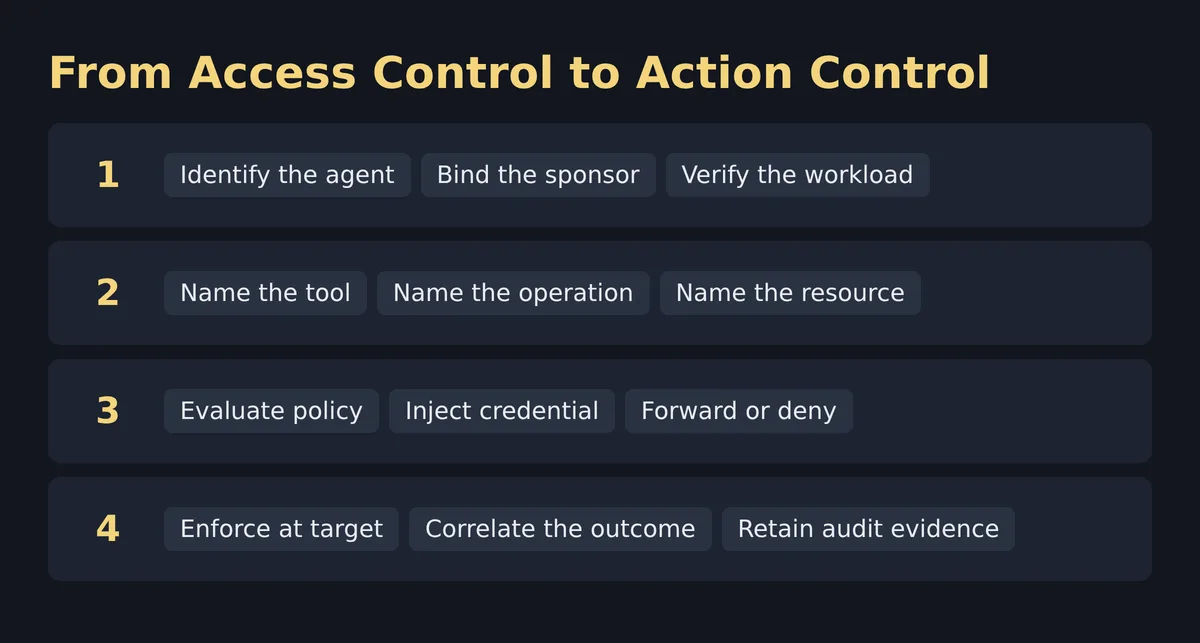
The delegation record should answer these questions without consulting chat history:
| Required field | Example of bounded evidence |
|---|---|
| Agent identity | Attested workload identity issued by the enterprise |
| Human or service sponsor | Directory identifier and owning team |
| Purpose | Named workflow or approved task class |
| Allowed actions | Explicit tool, method, and resource patterns |
| Conditions | Time window, source network, approval state, risk threshold |
| Credential reference | Vault reference, not the secret value |
| Parent delegation | Traceable parent identity and non-expandable scope |
| Revocation path | Identity disablement, token revocation, and network isolation |
According to NIST (2026), SCIM supplies lifecycle-management APIs rather than authentication or authorization. That distinction is operationally important: provisioning an agent identity is not permission to act. Joiners, changes, and removals for non-human identities need the same discipline as workforce identities, plus automated expiry for temporary agents.
Engineers preparing for identity and policy work can connect this model to the CCIE Security track overview and the Cisco ISE DISA STIG workflow. The protocols differ, but the review questions remain familiar: who is the subject, what context is trustworthy, where is policy evaluated, what enforces the result, and which evidence demonstrates the decision?
What should an AI agent authorization audit record contain?
An audit record should correlate the agent identity, sponsoring principal, input provenance, requested operation, policy version, credential reference, enforcement verdict, target response, and any downstream delegation. According to NIST (2026), agent governance needs logging and transparency tied to the non-human identity, provenance for prompts and data inputs, and support for auditing and non-repudiation. A transcript alone is not enough. It can show what the model said, but not which policy was loaded, whether a gateway altered the request, which credential was injected, or whether the target accepted the operation. Generate one correlation identifier before planning begins and propagate it through the runtime, gateway, MCP server, API, network telemetry, and target audit log. Protect those records from modification by the agent and retain enough policy context to reproduce the decision later.
I would test the control plane with denied actions before trusting successful ones. Ask a lab agent to read an approved object, write to a protected object, invoke an unapproved tool, follow an instruction embedded in retrieved content, delegate beyond its own scope, and connect directly around the gateway. The expected result is not “the model refuses.” The expected result is a denial at the relevant enforcement point plus a correlated audit event.
Use this review checklist:
- Enumerate every agent identity. Include ephemeral workers and delegated child agents, then assign an owner and purpose.
- Map every reachable dependency. Record models, skills, MCP servers, APIs, data stores, network destinations, and management systems.
- Separate instructions from data. Preserve provenance and prevent retrieved content from silently becoming privileged control input.
- Move secrets out of context. Store credentials in a vault and inject them only after an external authorization verdict.
- Enforce per operation. Distinguish read, create, update, delete, approve, merge, execute, and administrative actions.
- Retain target-side controls. Make the API, repository, database, or device reject unauthorized operations independently.
- Correlate the evidence. Join runtime, gateway, identity, network, tool, and target events with one request identifier.
- Exercise revocation. Disable the identity, revoke active grants, isolate network access, and verify that child delegations stop.
The control objective is straightforward: compromise of a prompt, skill, model session, or single tool must not silently become compromise of every resource the agent can name. That is the same containment mindset used in zero-trust network design, applied to a workload that can choose its next action.
Frequently Asked Questions
What is an AI agent trust boundary?
An AI agent trust boundary is the point where identity, data, tools, credentials, or delegated authority crosses into a different control domain. Treat every crossing as an explicit authentication, authorization, validation, and logging decision.
Where should AI agent authorization be enforced?
Enforce hard permissions outside the agent runtime at an identity-aware gateway and again at the target resource. The model can supply context, but it must not be the final authority on whether its own action is allowed.
How do you apply zero trust to AI agents?
Give each agent a managed non-human identity, grant least-privilege and task-scoped rights, verify every tool action, keep credentials outside the model context, segment reachable services, and log the authorization result.
Is MCP authentication enough to secure an AI agent?
No. Authentication establishes an identity, while authorization decides whether a specific agent may perform a specific operation on a specific resource. MCP deployments still need external policy enforcement, target-side permissions, credential isolation, and audit evidence.
To discuss identity, segmentation, and policy-design practice, contact FirstPassLab on Telegram. Treat the lab as a place to prove boundaries with denied traffic and attributable decisions, not merely to confirm successful access.