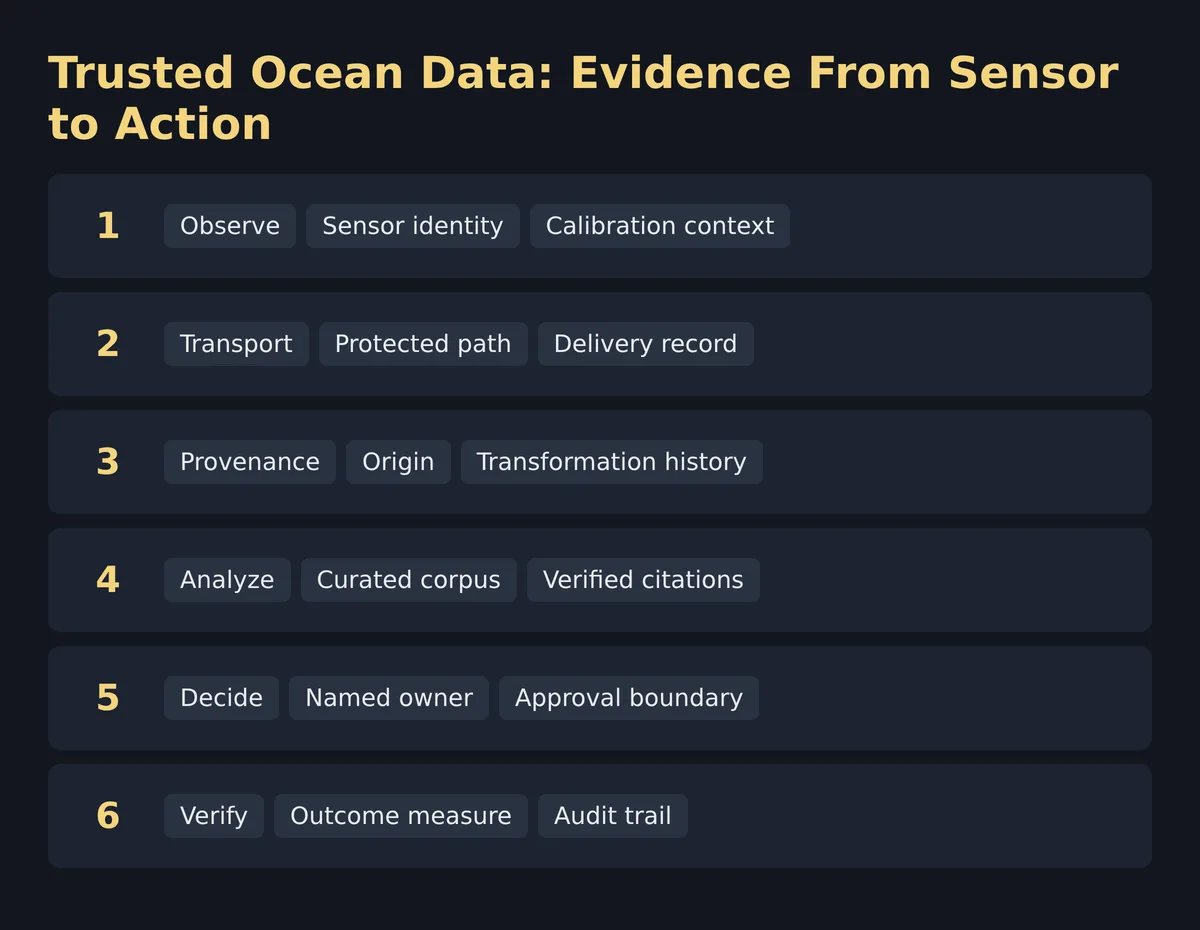
Trusted ocean data becomes actionable AI only when engineers can trace a decision back through the model, transformations, transport path, and original measurement. According to npj Ocean Sustainability (2026), an ocean-specific system evaluated across 25 policy questions produced no fabricated references, while the tested general-purpose baselines averaged more than 95% invalid citations. The lesson for network architects is direct: connectivity makes data available, but provenance, validation, observability, and accountable ownership make it usable.
Key Takeaway: Treat ocean AI as a governed decision system, not a dashboard project: preserve evidence from field measurement to operational action and measure whether the action produced the intended result.
What architecture turns ocean data into trustworthy decisions?

The useful architecture is a six-stage chain: observe, transport, preserve provenance, analyze, decide, and verify outcomes. Each stage needs its own owner, health signal, and failure policy. Cisco’s September 2026 proposal connects secure connectivity, real-time telemetry, observability, and AI analytics, but that proposal should be read as an operating model rather than proof of an ocean deployment. The network team owns packet delivery and infrastructure evidence; scientific partners own measurement validity; data stewards own schemas and lineage; model operators own retrieval and inference controls; and decision owners remain accountable for action. This division matters because a green WAN dashboard cannot prove that a carbon-dioxide sensor is calibrated, just as a scientifically valid observation cannot prove that an AI response cited it correctly. A robust design keeps those questions separate while joining their evidence in one traceable record.
| Stage | Required evidence | Useful engineering signal | Failure response |
|---|---|---|---|
| Observation | Sensor identity, calibration context, timestamp, location | Sample continuity and clock status | Quarantine suspect measurements |
| Transport | Authenticated source, protected path, delivery record | Loss, latency, retries, queue age | Buffer, reroute, or declare a gap |
| Provenance | Immutable origin and transformation history | Schema version and lineage completeness | Reject untraceable records |
| Analysis | Curated corpus, model version, retrieved sources | Citation resolution and retrieval coverage | Withhold unsupported output |
| Decision | Named user, policy boundary, approval record | Recommendation age and reviewer status | Escalate or require human approval |
| Outcome | Defined operational and environmental measure | Baseline-versus-result comparison | Reassess the intervention |
This pattern extends the control model in our guide to controlled enterprise AI deployment: data residency is only one control. Ocean systems also need field context, intermittent-link handling, scientific quality flags, and a clear distinction between an observation and an inference.
How should the observation and transport layers work?
The observation and transport layers should preserve the identity and context of every measurement before optimizing for speed. Team Malizia describes using its vessel to collect ocean measurements for the scientific community, while Cisco identifies temperature, salinity, carbon-dioxide concentration, and biodiversity as examples of the broader data landscape. Those sources establish the measurement purpose, but a production design still needs an explicit record for sensor identity, time source, calibration state, location, units, sampling method, and validation status. The transport path should add authenticated device identity, encryption, store-and-forward behavior, and delivery acknowledgement without rewriting the scientific record. Engineers should expect disconnected operation: a research vessel or coastal station can remain scientifically useful during a WAN outage if it timestamps and buffers data correctly. The pipeline should mark delay and loss honestly rather than silently interpolating observations or presenting stale data as current.
A practical telemetry contract separates three planes:
- Capture observations with the original timestamp, units, instrument identity, and quality flag intact.
- Record transport state such as link availability, delivery attempts, latency, packet loss, and backlog age as separate operational metadata.
- Validate ingestion against an approved schema and reject impossible types, missing provenance, or unrecognized sources.
- Preserve raw records before normalization so later reviewers can reproduce transformations.
- Publish quality status with the dataset instead of hiding gaps behind a single availability indicator.
This is where familiar network practice becomes useful. The layered timing method in our distributed latency monitoring guide applies directly: isolate name resolution, session establishment, encryption, application response, and transfer rather than treating “reachable” as “healthy.” Do not use network telemetry to infer scientific accuracy. Use it to prove when and how the scientific payload moved.
Why does provenance matter before AI analysis?
Provenance matters because an AI answer is only as defensible as the evidence chain behind each claim. A trustworthy record identifies where data originated, which transformations changed it, which quality controls were applied, and which version entered the model’s retrieval context. According to npj Ocean Sustainability (2026), IPOSGPT was grounded in a curated collection of peer-reviewed literature, intergovernmental reports, and environmental policy documents. Across 25 policy-relevant queries, the paper reported zero fabricated references for IPOSGPT and more than 95% invalid citations on average for the tested general-purpose baselines. That result does not prove that every domain-specific model is accurate. It does show why citation verification and corpus control must be designed into the service instead of added after a convincing answer appears. For high-stakes sustainability work, an unresolved citation should be an observable failure, not a cosmetic defect.
| Control | Weak implementation | Trustworthy implementation |
|---|---|---|
| Source identity | Filename or free-text label | Stable identifier, publisher, date, and resolvable location |
| Transformation history | Latest value only | Ordered lineage with code or rule version |
| Quality state | One “valid” flag | Measurement, transport, validation, and review states kept separate |
| AI grounding | Unrestricted model memory | Curated retrieval corpus with source-level permissions |
| Citation handling | Generated reference text | Resolution check against the retrieved source |
| Reproducibility | Saved final answer | Query, corpus snapshot, model version, prompts, and reviewer decision |
The same discipline appears in our AI digital resilience lifecycle: govern the system, map dependencies, measure behavior, and manage risk continuously. For ocean data, the dependency map should include instruments, edge gateways, satellite or terrestrial links, brokers, object stores, catalogs, retrieval indexes, models, dashboards, and the institutions that authorize action.
Where should AI sit in the ocean data pipeline?
AI should sit after validated ingestion and before an accountable decision boundary, where it can summarize evidence, detect patterns, or support retrieval without becoming the source of record. The model should never overwrite raw observations or silently promote its own estimate into a measured field. Its output needs a model identifier, corpus snapshot, retrieval trace, citations, confidence or abstention status, and the identity of any human reviewer. A useful operational rule is to separate “what was measured,” “what the system inferred,” and “what a person or institution decided.” This keeps a model update from changing historical observations and prevents fluent text from bypassing scientific review. The architecture should also offer a safe degraded mode: if citations fail, the corpus is stale, or provenance is incomplete, the system can return the underlying records or abstain instead of producing an unsupported recommendation.
The placement resembles the guarded workflow described in edge AI manufacturing decisions. In both cases, the model provides analysis inside a defined boundary; it does not acquire unlimited authority over the physical process. Network architects should test identity, segmentation, data flow, dependency loss, model rollback, and audit export before enabling any automated downstream action.
How do partnerships turn a data platform into public value?
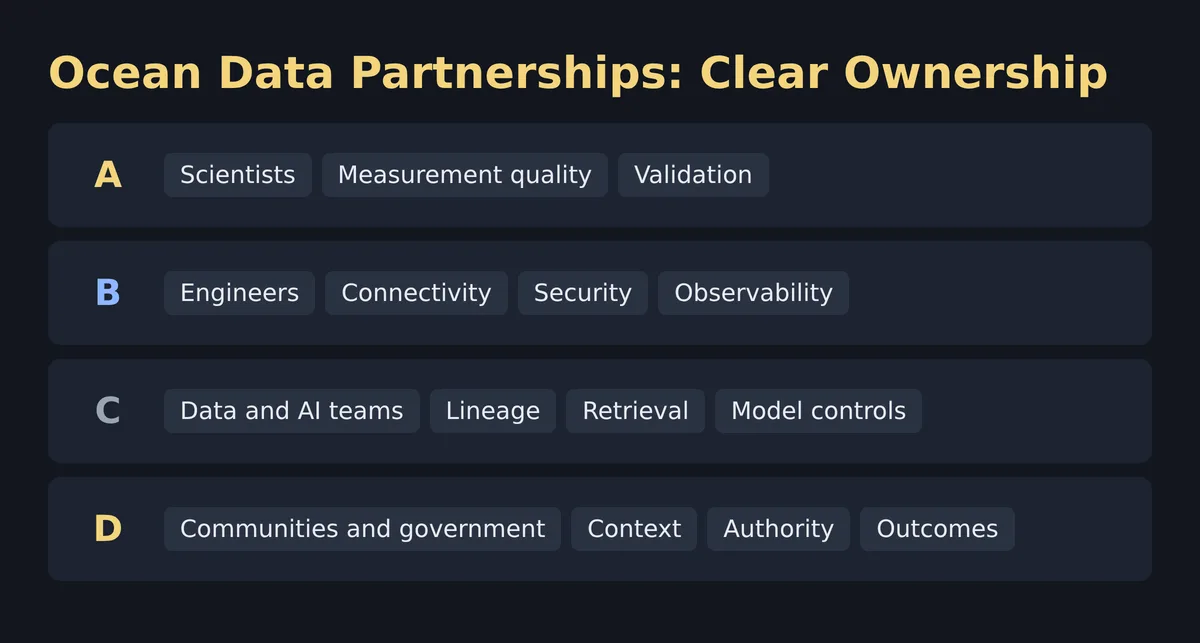
Partnerships create public value when each participant owns a distinct control and the group agrees on interoperable evidence, decision rights, and outcome measures. UNESCO-IOC’s September 2026 account of the Coastal & Ocean Resilience Data Collaborative describes an open digital public infrastructure that brings together oceanographic, weather, socioeconomic, infrastructure, finance, and citizen-reported information. It also describes community participation, standardized data, interoperability, and near-real-time insight for hazards, vulnerabilities, and exposure. That is materially broader than installing sensors or building a dashboard. Scientists establish measurement methods; communities supply local context and help define useful outcomes; government bodies set policy and accountability; technology providers operate infrastructure; and implementation partners join systems without erasing source ownership. The hard interface is institutional as much as technical: every recommendation needs a known audience with the authority and resources to act.
Cisco’s industrial example illustrates the distinction between a demonstrated result and an analogy. According to Cisco (2026), Bosch Rexroth reported 10–15% lower energy consumption, 25–30% lower greenhouse-gas emissions, and 20–30% lower energy costs at its model factory in Ulm. Those are company-reported factory outcomes, not ocean outcomes. They support the narrower point that observability linked to operational changes can be measured. An ocean program must define its own baselines, interventions, and validation method before making an equivalent claim.
The architecture also benefits from the dependency thinking in our network digital twin guide, but a simulation or dashboard remains an aid to judgment. It is not evidence that a community’s risk decreased.
What should network architects test before production?
Network architects should test evidence continuity and failure behavior before testing presentation quality. Start with a known measurement and prove that an auditor can trace it through ingestion, normalization, retrieval, model output, review, and final use. Then break each dependency deliberately: corrupt a timestamp, delay a batch, rotate a device identity, change a schema, withdraw a source, block citation resolution, replace a model, and disconnect the dashboard. The expected response should be explicit for each fault—buffer, reject, mark stale, abstain, require approval, or fall back to raw evidence. A polished answer is not the acceptance criterion. The criterion is whether operators can distinguish measurement failure, network failure, data-quality failure, retrieval failure, model failure, and decision-process failure without guessing.
Use this production checklist:
- Define ownership for instruments, transport, datasets, models, reviews, decisions, and outcome reporting.
- Trace one record end to end, including every transformation and quality-state change.
- Test disconnected operation and confirm that buffered data retains original time and provenance.
- Inject schema and identity failures and verify that untrusted records cannot enter the approved corpus.
- Break source resolution and require the AI service to abstain or expose the missing evidence.
- Exercise model rollback while preserving the ability to reproduce earlier outputs.
- Separate dashboards for infrastructure health, scientific quality, AI quality, and decision outcomes.
- Review authority boundaries so recommendations cannot become actions without the required approval.
For a broader practice path, the FirstPassLab blog connects these controls to observability, security, automation, and infrastructure design. The central habit is consistent across domains: preserve evidence, test failure modes, and make operational ownership visible.
Frequently Asked Questions
The short answers below define the minimum trust boundary for ocean data and AI. They are intentionally stricter than “the dashboard loaded” because availability, scientific validity, model faithfulness, and decision accountability are different properties. A system can pass one test and fail the others. Network engineers contribute most effectively by proving identity, path behavior, timing, segmentation, observability, and recovery while leaving scientific validation and public-policy authority with the appropriate experts. The result is a joint assurance model: no single platform or institution claims more certainty than its evidence supports, and every operational user can see whether data is measured, inferred, delayed, disputed, or approved.
What makes ocean data trustworthy for AI?
Trustworthy ocean data has documented origin, calibration and validation context, protected transport, traceable transformations, and explicit quality status. The AI output must preserve links back to that evidence.
What should network engineers monitor in an ocean data pipeline?
Monitor sensor identity, collection gaps, clock quality, transport loss, queue age, schema changes, validation status, model versions, citation resolution, and delivery to the operational user. Separate infrastructure health from scientific data quality.
Can a general-purpose AI safely answer ocean policy questions?
Not without grounding, citation verification, and human review. According to npj Ocean Sustainability (2026), the tested general-purpose baselines averaged more than 95% invalid citations across the study’s 25 policy questions, so fluent output alone is not sufficient evidence.
If you are building the networking, observability, or security skills needed to reason through pipelines like this, start a training consultation with FirstPassLab on Telegram. We can discuss the practice direction that matches your current engineering role.