FRMCS changes rail network modernization by turning a radio replacement into a full critical-infrastructure migration. The target is a 5G-based, application-aware communications system in which railway services are separated from transport, GSM-R and FRMCS coexist during transition, and operational control remains explicit across public, private, and shared infrastructure. For a service provider engineer, the hard problem is not selecting a faster radio. It is preserving mission-critical behavior while changing access, core, application, security, and assurance domains together.
Key Takeaway: Treat FRMCS as a staged service-architecture migration with measurable safety, interoperability, sovereignty, and operations requirements—not as a 5G coverage project.
What Is FRMCS, and Why Is GSM-R Being Replaced?
FRMCS is the Future Railway Mobile Communication System: a worldwide railway telecommunications framework developed by the International Union of Railways as the successor to GSM-R. According to UIC (2023), GSM-R is based on second-generation mobile technology, supports operational communications within the European Railway Traffic Management System, and is expected to lose vendor support around 2035. FRMCS addresses that lifecycle risk while creating a transport foundation for mission-critical voice, operational data, train control, and later digital services. The architectural shift matters more than the air interface: applications can be decoupled from the underlying transport, allowing railway functions to use suitable access without embedding their lifecycle in one radio generation. That model resembles the separation SP engineers already apply between customer services and packet transport, but rail adds demanding safety, availability, mobility, and cross-border interoperability constraints.

UIC describes GSM-R as deployed across more than 130,000 kilometres of European track and 210,000 kilometres worldwide. According to UIC (2023), those figures explain why a flash cutover is unrealistic: installed radios, trackside systems, operational procedures, spectrum, and national deployment schedules all move at different rates. The practical design question is therefore how to preserve railway applications while the transport beneath them changes.
That is a useful mental model for anyone studying CCIE Service Provider as a current engineering track. FRMCS brings familiar disciplines—routing isolation, QoS, multicast behavior, timing, telemetry, and failure-domain design—into a tightly governed operational environment.
How Should Engineers Design GSM-R and FRMCS Coexistence?
Engineers should design coexistence as a controlled multi-domain state, not a temporary exception that receives less engineering rigor than the destination. According to UIC (2023), GSM-R and FRMCS are intended to operate alongside each other during migration, with the first implementable FRMCS specification planned for inclusion in the CCS TSI in 2027. That means every service needs an explicit migration state: legacy only, dual served, or FRMCS native. Each state needs ownership, acceptance criteria, monitoring, incident procedures, and a rollback path. Radio coverage is only one dependency. Teams must also trace train-borne equipment, trackside gateways, mission-critical application servers, identity, addressing, interconnection, operations support systems, and links to external mobile operators. If those dependencies are not visible in one service model, a nominally redundant design can still hide a shared failure point.
| Migration concern | Engineering question | Evidence to collect |
|---|---|---|
| Service continuity | Which railway function remains available if either access domain fails? | Failure tests and application-level outcomes |
| Interworking | Where do calls, sessions, identities, and policy cross domains? | Interface inventory and packet traces |
| Coverage | Which route segments depend on one radio system? | Survey data linked to operational routes |
| Operations | Can one team correlate alarms across legacy and target stacks? | Shared incident timeline and telemetry mapping |
| Rollback | What returns a migrated service to its last safe state? | Rehearsed rollback procedure and decision owner |
ETSI provides a useful reality check. According to ETSI (2025), its fifth railway communication Plugtests event ran 96 sessions and reported a 95.5% interoperability success rate across the tested configurations. That is strong progress, but it is not proof that every vendor combination, railway application, roaming arrangement, or brownfield topology is production ready. It shows why formal interoperability testing must sit inside the migration plan.
What Does the FRMCS Architecture Separate?
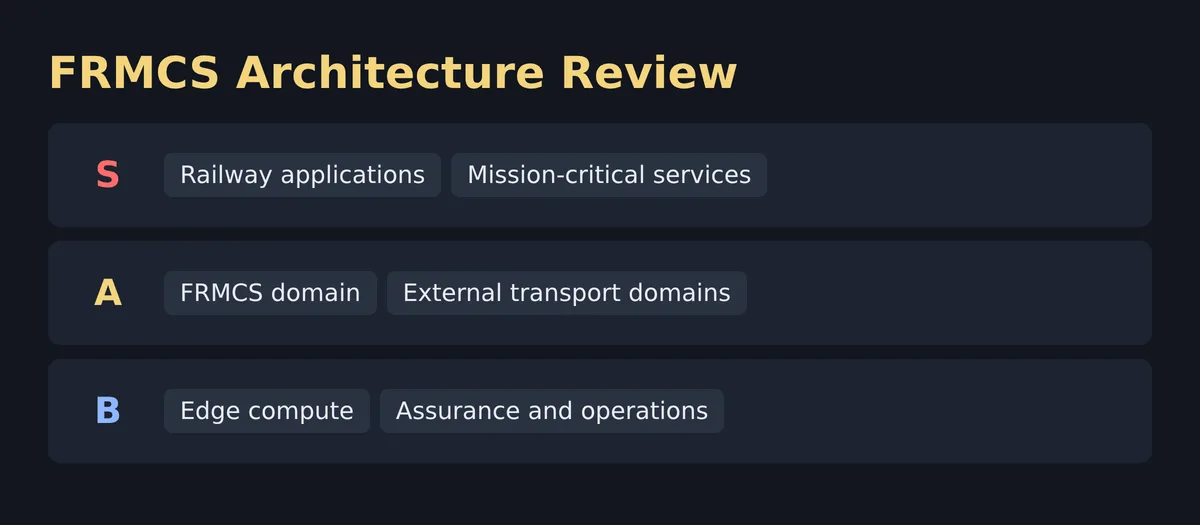
The FRMCS architecture separates railway applications, communications services, transport domains, and operational responsibility so that each boundary can be specified and tested. ETSI TS 103 764 distinguishes an FRMCS domain under an FRMCS operator’s control from external transport domains that can provide connectivity. In engineering terms, the application should request a communications behavior without assuming that one access network, one carrier, or one vendor appliance always provides it. This separation creates flexibility, but it also creates contracts: identity propagation, QoS mapping, session continuity, encryption, observability, and fault escalation must remain coherent across domain boundaries. Service provider teams should model the end-to-end service first and then place components. Starting with product boxes encourages local redundancy while leaving inter-domain behavior ambiguous.
A practical architecture review should distinguish standards-defined functions from project choices:
| Layer | Standards-led concern | Project-specific decision |
|---|---|---|
| Railway application | Required communication behavior and interfaces | Application hosting and release process |
| Mission-critical services | Group communication, session handling, and service continuity | Platform vendor and deployment topology |
| Transport | Reachability, QoS, resilience, and mobility support | Private, public, or hybrid network mix |
| Edge compute | Connectivity and workload boundaries | Hardware, orchestration, and placement policy |
| Assurance | Observable service outcomes | Toolchain, data retention, and automation controls |
This separation also helps engineers avoid treating every 5G feature as an FRMCS requirement. Network slicing in a 5G standalone core can be relevant to isolation and service policy, but its presence does not replace end-to-end railway application validation.
What Does Network Sovereignty Mean for Rail Communications?
Network sovereignty in rail means retaining accountable control over critical services, data, operations, dependencies, and recovery even when the architecture uses external providers. It does not automatically mean that every component must be manufactured or hosted within one country. Directive (EU) 2022/2555, commonly called NIS2, includes rail infrastructure managers and railway undertakings within its transport scope and establishes cyber-risk management and incident obligations. Architecture teams therefore need to identify who can operate each control plane, where sensitive operational data flows, which licenses or cloud services can interrupt continuity, how suppliers are assessed, and which organization owns restoration. The resulting design can still be multi-vendor and hybrid, but responsibility cannot disappear at a contract boundary. Sovereignty becomes testable when each dependency has an owner, exit path, recovery method, and evidence trail.
The distinction is especially important when vendors use “sovereign” as a portfolio label. A procurement team should translate that label into questions about administrative access, key custody, software update authority, telemetry export, data retention, offline operations, supply-chain visibility, and license failure. The same discipline appears in European telecom sovereign-cloud architecture, where residency alone does not prove operational independence.
Where Does Edge AI Fit in an FRMCS Rail Network?
Edge AI fits beside FRMCS when a railway workload benefits from local sensor processing, bounded latency, reduced upstream traffic, or tighter control of sensitive data; it is not part of the FRMCS mandate itself. Europe’s Rail documents a wayside pantograph monitoring solution that combines high-resolution cameras, image processing, artificial intelligence analytics, and three-dimensional reconstruction to assess equipment condition. That is a credible pattern: acquire data near the asset, process the heavy stream locally, send events and selected evidence upstream, and keep the communications service observable. FRMCS can contribute connectivity, but the workload still needs its own safety classification, compute platform, model governance, storage policy, and degraded-mode behavior. Engineers should resist connecting an AI result directly to an operational action until the consequence, confidence threshold, human authority, and rollback path are defined.
An edge design review should answer four questions:
- Define the operational decision. State whether the workload informs inspection, raises an alarm, or controls equipment.
- Bound the data path. Identify what stays local, what crosses the network, and what evidence must be retained.
- Specify degraded behavior. Decide what the railway service does when compute, model, sensor, or transport is unavailable.
- Separate inference from authority. Require an explicit policy layer before an AI output can cause an operational change.
The same guardrail principle applies to agentic AI in network operations: useful automation starts with deterministic tools, observable state, approval boundaries, and reversible actions.
How Can Engineers Separate Standards from Vendor Claims?
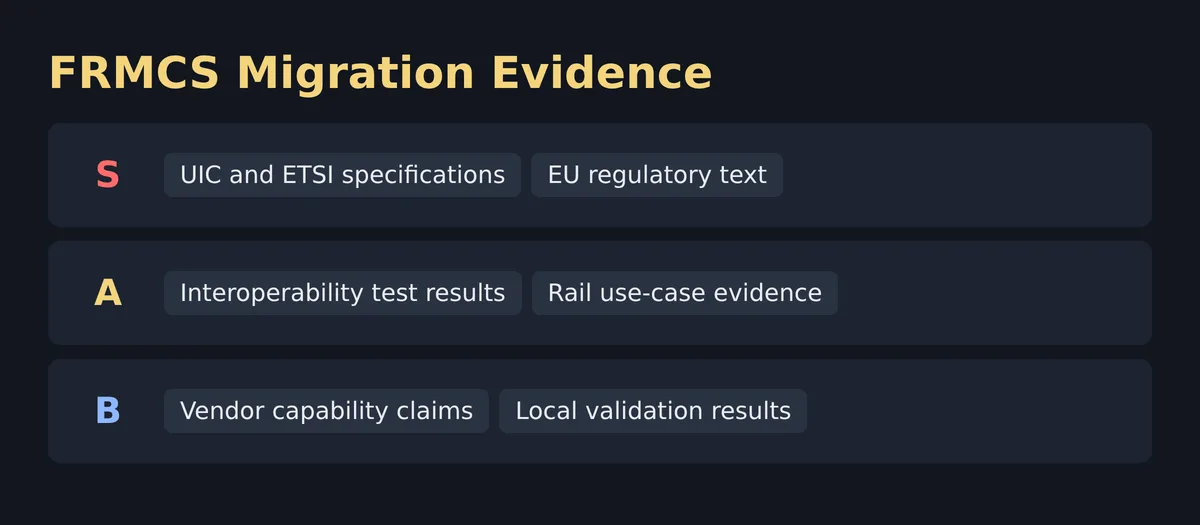
Engineers can separate standards from vendor claims by building a requirement-to-evidence matrix before evaluating platforms. Put each claim into one of four columns: mandated by regulation, specified by an industry standard, demonstrated in an interoperability test, or asserted by a supplier. Cisco’s FRMCS article presents edge, assurance, automation, and sovereign-infrastructure capabilities as an integrated modernization approach. Those ideas can be evaluated, but Cisco product positioning is not itself a UIC, ETSI, or NIS2 requirement. Likewise, a claim about extremely fast assurance or pervasive closed-loop automation needs a defined measurement point, workload, topology, and failure condition before it belongs in a design baseline. The matrix keeps a useful vendor capability from being mistaken for a universal obligation and prevents a standards citation from being used to validate an unrelated product promise.
| Claim class | Appropriate evidence | Design response |
|---|---|---|
| Regulatory obligation | Current legal text and competent-authority guidance | Assign accountability and compliance evidence |
| Standards requirement | Versioned UIC, ETSI, 3GPP, or IETF document | Map interfaces and conformance tests |
| Interoperability result | Published test scope and configurations | Reproduce relevant combinations locally |
| Vendor capability | Product documentation and witnessed test | Validate against the railway use case |
This is also the right way to study evolving mobile infrastructure. Our MWC analysis of AI-native mobile networks is useful context, but a conference roadmap should never be treated as a deployed rail requirement.
What Should a Service Provider Engineer Validate First?
A service provider engineer should validate the end-to-end railway service and its failure behavior before optimizing individual network elements. Start with one operational flow, identify every application and transport boundary, and document the safe outcome when each dependency fails. Then verify identity, QoS, routing, multicast or group communication, timing, encryption, telemetry, and operational ownership across both GSM-R and FRMCS states. The lab should include realistic impairment and restoration events rather than only successful call setup. It should also preserve evidence that application owners, radio teams, core teams, security teams, and operations staff can interpret together. This approach turns a broad modernization programme into bounded experiments while keeping the result connected to the railway function that matters.
A practical validation sequence is:
- Select one railway service and define its required outcome in normal and degraded conditions.
- Map every dependency across onboard equipment, radio access, transport, core services, applications, and operations.
- Document domain contracts for identity, addressing, QoS, security, telemetry, and escalation.
- Build coexistence states that represent legacy-only, dual-served, and target operation.
- Inject failures at inter-domain boundaries and record application-visible behavior.
- Rehearse restoration with the teams and authority model that will operate the production service.
- Evaluate vendor platforms only after the required outcomes and evidence are clear.
For engineers building the transport and assurance foundation, the FirstPassLab Service Provider article collection provides related material on routing, mobile core, automation, and sovereignty. FirstPassLab is an independent training site and is not affiliated with UIC, ETSI, Cisco, or any railway operator.
Frequently Asked Questions
FRMCS questions usually reduce to scope, migration timing, and the boundary between standardized communications and implementation choices. The concise answers below follow the evidence available from UIC, ETSI, the European Union, and Europe’s Rail. They deliberately avoid promising a universal cutover date or prescribing one vendor architecture, because national programmes, installed systems, spectrum, and operational requirements differ. The durable engineering position is to treat coexistence as a production state, verify application behavior across domain boundaries, and demand specific evidence for every regulatory, standards, interoperability, or product claim. That produces a migration design that can evolve as specifications mature without tying railway applications to one access generation or confusing marketing language with a mandatory technical control.
What is FRMCS and why is it replacing GSM-R?
FRMCS is the Future Railway Mobile Communication System, designed by UIC as the worldwide successor to GSM-R. It separates railway applications from transport and adds a standards-based path for mission-critical voice, data, and future digital rail services.
Will FRMCS and GSM-R operate at the same time?
Yes. UIC’s migration plan explicitly includes parallel operation, so engineers must plan interworking, coverage, operations, and rollback across both systems rather than treat migration as a single cutover.
Does FRMCS require a specific vendor edge platform?
No. FRMCS standards define railway communications requirements and interfaces, while a vendor edge or assurance platform is an implementation choice. Buyers should map every platform claim to an operational requirement and test it independently.
If you are preparing for Service Provider work involving 5G transport, mission-critical services, or resilient multi-domain operations, contact FirstPassLab on Telegram to discuss a relevant hands-on training path.