A mock lab gives you more than a percentage. It shows how your technical knowledge behaves when time, uncertainty, verification, and recovery all compete for attention. The useful question is not, “Did I pass this mock?” It is, “What evidence does this run provide about my ability to perform again?”
That distinction matters before you spend money and lock in a date. Cisco describes the current CCIE Enterprise Infrastructure lab as an eight-hour, hands-on exam testing the ability to plan, design, operate, and optimize dual-stack solutions for complex enterprise networks. Cisco also says candidates who fail an Expert-level lab or practical exam must wait 30 calendar days, beginning the day after the failed attempt, before scheduling the same exam again. A booking decision should therefore be based on repeatable operating behavior, not a single high score.
This framework works whether you are preparing for CCIE Enterprise Infrastructure, CCIE Security, CCIE Data Center, CCIE Service Provider, or Cisco Certified DevNet Expert. It does not depend on disclosing any protected lab content.
Start with four dimensions, not one percentage
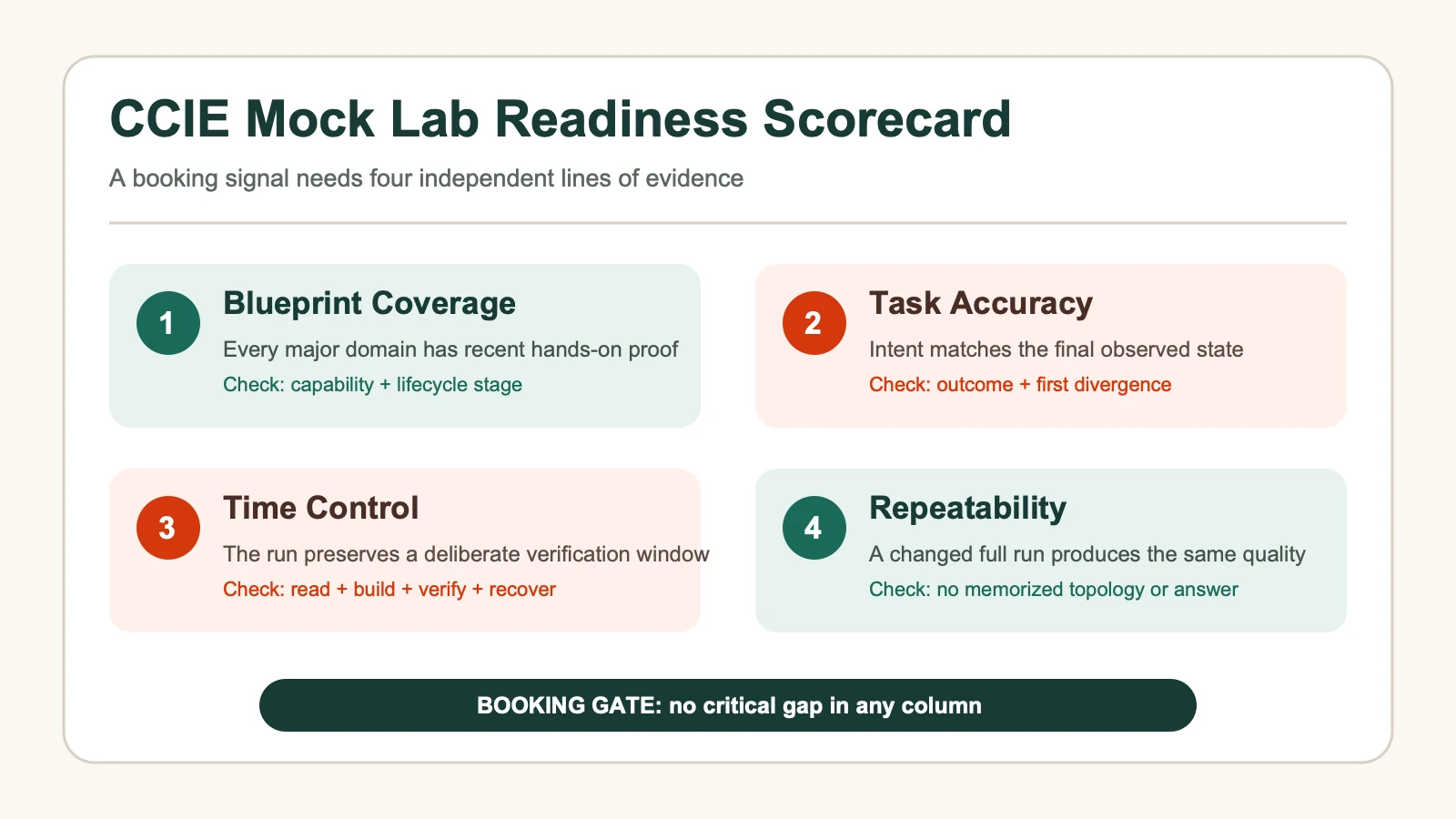
Use four separate evidence columns after every full mock: blueprint coverage, task accuracy, time control, and repeatability. A result is only booking-grade when none of the four contains a critical gap.

1. Blueprint coverage
Map each task to the current blueprint before looking at the final score. A strong total can conceal a weak domain if the mock under-sampled it. Conversely, a weak total may be driven by one concentrated gap that is practical to repair.
For each blueprint domain, record:
- whether it appeared in the run;
- whether you recognized the required outcome without prompting;
- whether you could produce a valid design or configuration path;
- whether you verified the result from the correct operational state.
Do not convert this into a checklist of commands. The blueprint describes capabilities, and Cisco’s current Enterprise Infrastructure blueprint explicitly spans planning, design, operation, and optimization. Your evidence should cover the same lifecycle.
2. Task accuracy
Separate “I knew the technology” from “the network ended in the required state.” For this review, judge the mock by whether the network reached the required observed state. A correct concept followed by a bad interface, wrong address family, incomplete policy attachment, or unverified dependency is still an execution failure.
For each task, capture three facts: the intended outcome, the final observed state, and the earliest point where they diverged. This makes the review diagnostic instead of emotional.
3. Time control
Completion time is not just the timestamp on the final task. Track how much time went to reading, building, verifying, and recovering. A candidate who finishes with minutes left after skipping verification is in a different position from one who finishes with a deliberate review window.
If your environment choice is still unstable, resolve that before interpreting speed. Our comparison of CML, INE, and GNS3 for CCIE preparation can help isolate platform friction from skill friction.
4. Repeatability
Repeatability is the strongest protection against a false positive. Run a second full mock with changed addressing, device roles, failure conditions, or task order. The scenario should test the same blueprint capabilities without inviting memorization.
Two similar results do not guarantee an exam pass. They do show that your process is less dependent on a favorable task set or a remembered answer. That is the level of evidence a booking decision needs.
Classify every lost point by failure mode
A remediation plan becomes much more precise when every miss belongs to one primary class. Use the earliest controllable cause, not the most visible final symptom.
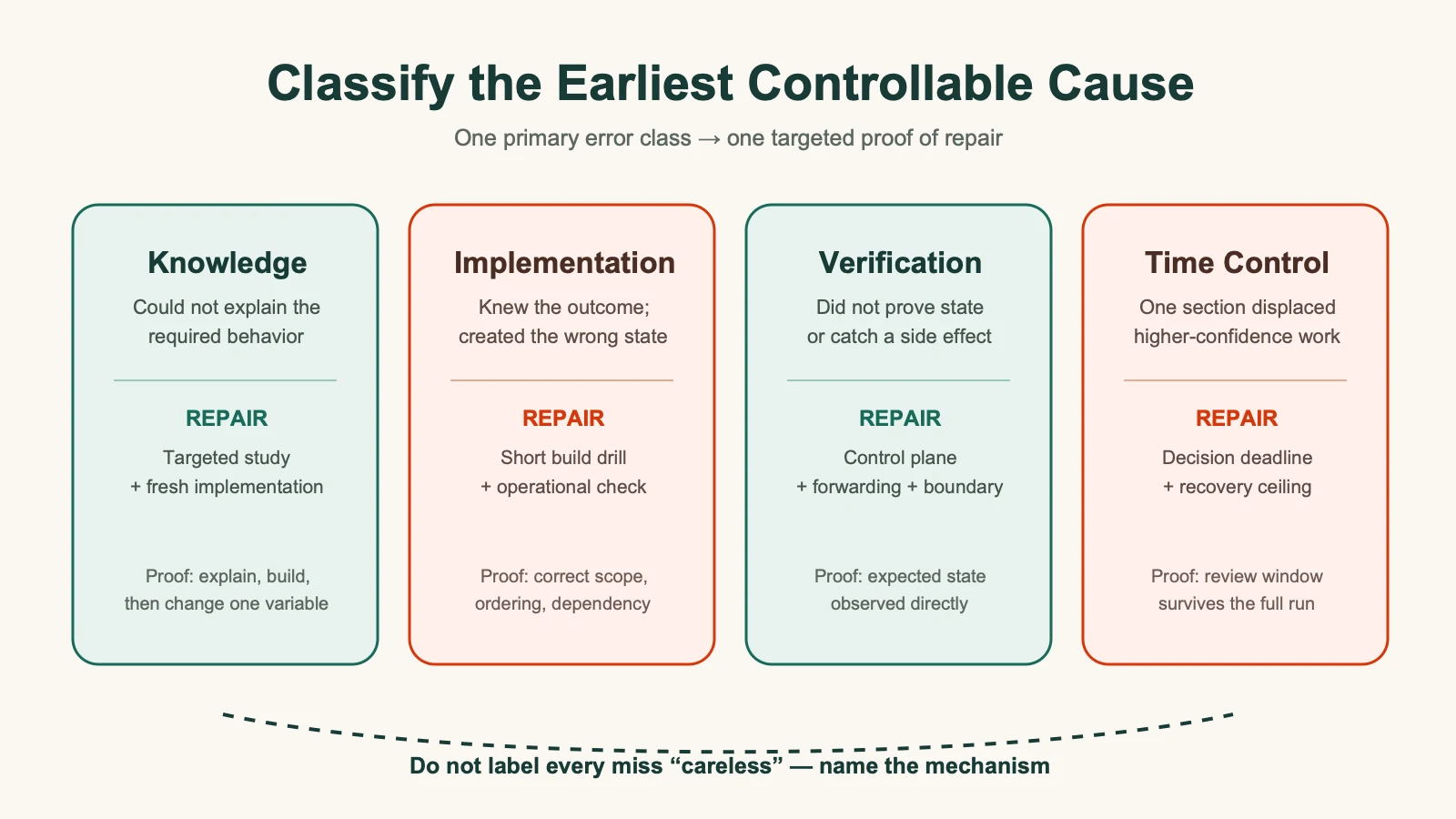
Knowledge gap
You could not explain the relevant control-plane or data-plane behavior well enough to choose a path. The fix is targeted study followed by a fresh implementation. Reading the solution alone is not evidence of recovery.
Implementation error
You understood the outcome but created the wrong state: incorrect scope, syntax, ordering, dependency, or attachment point. The fix is a short build-drill that ends with operational verification, then a second drill with one variable changed.
Verification gap
The configuration may have looked plausible, but you did not prove the required state or failed to notice a side effect. Build a compact verification chain: expected control-plane state, expected forwarding behavior, and one negative or boundary check when relevant.
Time-control error
You spent too long reading, troubleshooting, or perfecting one section and displaced work you could have completed. The fix is not simply “type faster.” Set decision deadlines, establish a maximum recovery window, and preserve time for high-confidence work and final validation.
If the mock failure is substantial, use a structured recovery cycle rather than immediately booking another date. The same principle underlies our CCIE lab recovery blueprint: diagnose, isolate, rebuild, and retest.
Turn the review into a booking gate
The gate below is deliberately stricter than “my average score went up.” It asks whether the evidence is complete enough to justify a real attempt.
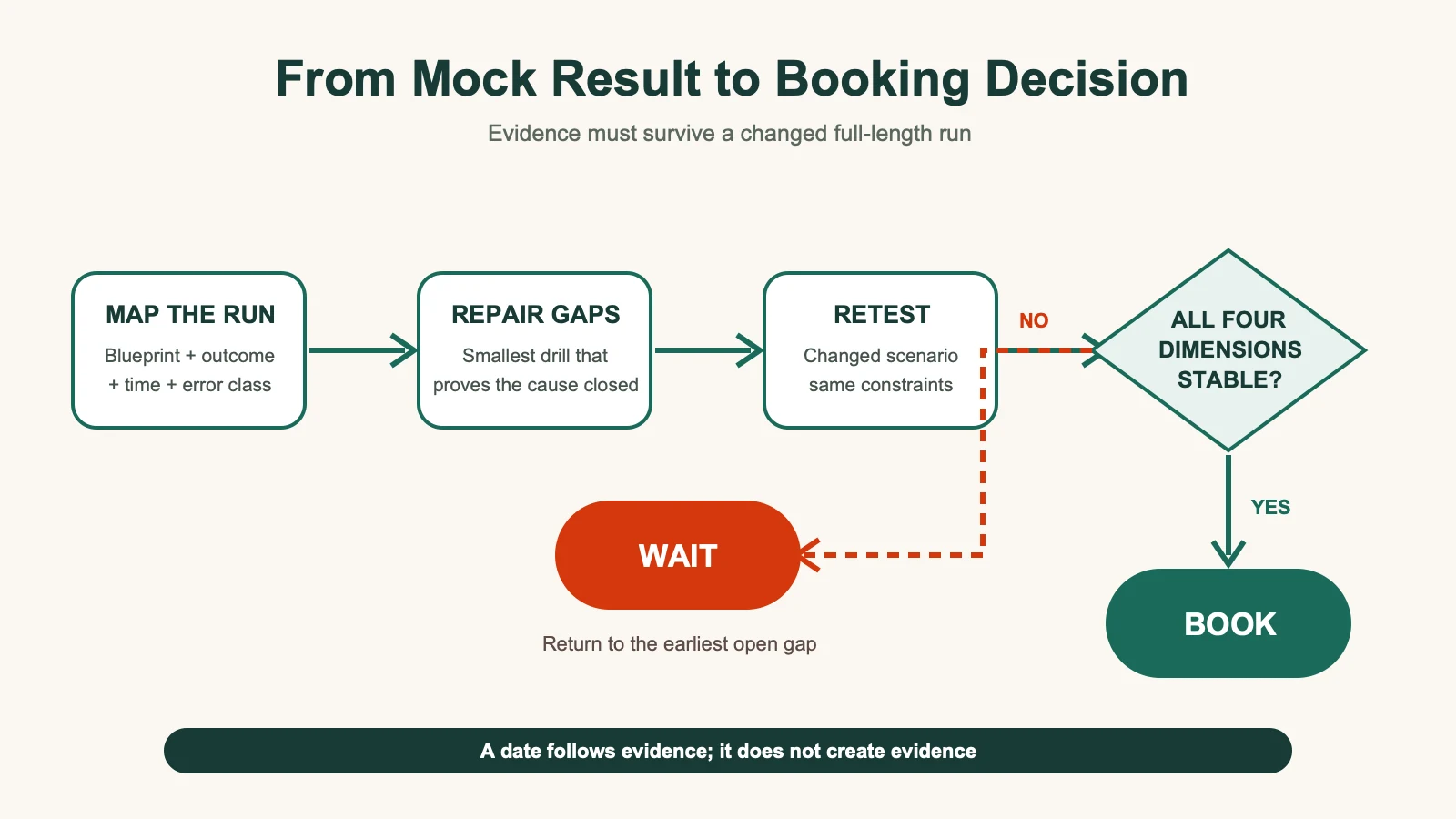
Book when all four statements are true
- Coverage: every major blueprint domain has recent hands-on evidence, and no critical domain is represented only by notes or videos.
- Accuracy: your remaining misses are isolated and explainable, not recurring failures in the same dependency or verification step.
- Time: you can complete the full run while preserving a deliberate verification window.
- Repeatability: you have reproduced the result in at least one changed, full-length scenario.
This is a professional judgment gate, not a claim about Cisco’s unpublished passing threshold. Cisco records lab and practical results as Pass or Fail and says failing reports identify areas where more study may help. Cisco does not publish exam passing scores; no mock percentage is a Cisco guarantee.
Wait when one of these patterns remains
- an important blueprint domain has not appeared in your recent mocks;
- the same failure class repeats after remediation;
- success depends on recovering a familiar topology from memory;
- verification is routinely postponed until time expires;
- one strong run is carrying an otherwise unstable trend.
Cisco’s preparation guidance places hands-on practice before a readiness assessment and scheduling. That ordering is useful: the date should follow the evidence, not create it. Cisco’s current policies also make late schedule changes costly and impose a 30-day wait after a failed expert lab or practical attempt, so leave enough calendar margin to make an honest decision.
Use official practice labs without corrupting your evidence
Cisco says its CCIE Practice Labs use environments and topologies representative of the certification lab environment. It also says the sessions do not provide solutions or verification steps, cannot be canceled, refunded, or rescheduled, and do not retain your configuration after the session.
That makes a practice session useful for observing your operating process, but only if you prepare the evidence sheet in advance. Record time allocation, domain-level confidence, error classes, and next actions without retaining protected pod, topic, scenario, topology, configuration, question, answer, or diagram details. Cisco’s confidentiality policy explicitly prohibits that disclosure.
For a broader preparation sequence, pair this review method with our first-attempt CCIE Enterprise Infrastructure lab guide and the site’s free lab resources. The goal is a closed loop: practice, observe, classify, repair, and prove the repair in a different run.
A compact post-mock worksheet
Immediately after the run, write one page with these fields:
| Field | What to record |
|---|---|
| Blueprint evidence | Domains tested, domains absent, lifecycle stages covered |
| Accuracy evidence | Intended state, observed state, first divergence |
| Time evidence | Reading, build, verification, and recovery time |
| Error class | Knowledge, implementation, verification, or time control |
| Remediation | Smallest drill that can prove the gap is closed |
| Retest condition | What will change so the next run cannot be memorized |
| Booking signal | Ready, conditional, or wait—with one sentence of evidence |
The worksheet should make your next action obvious. If it only says “study more,” the review is not finished. Name the blueprint capability, the failure mode, the drill, and the retest condition.
Final judgment
A CCIE mock lab is valuable when it changes your next week of work. The headline score is only the entry point. Blueprint coverage tells you whether the sample was complete; task accuracy reveals whether knowledge became a correct network state; time control shows whether your process survives pressure; repeatability tells you whether the result is real.
Book when those four lines of evidence agree. Wait when one of them is still asking you to rely on hope.