The Weight of AI Models: Why Network Infrastructure Is Lagging Behind the AI Boom

AI models are outgrowing network infrastructure because the hard part is no longer just training a model once. The hard part is repeatedly moving 140 GB to 1 TB artifacts, placing them on the right GPU nodes, and serving them with predictable latency during bursty inference demand. According to the CNCF Annual Cloud Native Survey (2026), 66% of organizations already use Kubernetes to host generative AI workloads, yet only 7% deploy models daily, which tells us the bottleneck is operational delivery, not lack of interest. ...
April 10, 2026 · 2:03 AM MST · News & Trends

NVIDIA’s $2B Marvell Bet: What NVLink Fusion Means for AI Data Center Networks

NVIDIA’s $2 billion investment in Marvell matters because it extends NVIDIA’s influence beyond GPUs and into the custom silicon, optical, and network-fabric layers that now determine whether AI clusters scale cleanly. According to NVIDIA (2026), the partnership ties Marvell’s custom XPUs and NVLink Fusion-compatible scale-up networking to NVIDIA’s Vera CPUs, ConnectX NICs, BlueField DPUs, NVLink interconnect, and Spectrum-X switches, which means customers can build semi-custom AI systems without leaving NVIDIA’s control plane. ...

April 8, 2026 · 11:31 AM MST · Data Center

Equinix Distributed AI Hub: What Network Engineers Need to Know About the DCI Architecture Powering Distributed AI

Equinix launched the Distributed AI Hub on March 11, 2026, creating the largest unified AI orchestration framework in the colocation industry — spanning 280 data centers across 77 markets worldwide. Powered by Equinix Fabric Intelligence, the platform automates connectivity, routing, and security policy enforcement for distributed AI workloads across colocation, edge, and multi-cloud environments. For network engineers, this represents a fundamental shift in how data center interconnect (DCI) architectures are designed, provisioned, and operated at scale. ...

March 31, 2026 · 2:02 AM MST · News & Trends

Nvidia Overhauls Data Centers for the OpenClaw Era: AI Grids, Vera Rubin POD, and What Network Engineers Must Know

Nvidia has declared the traditional data center dead. At GTC 2026, CEO Jensen Huang unveiled a complete architectural overhaul that replaces file-serving buildings with AI factories purpose-built for token generation — and the catalyst is the agentic AI explosion driven by OpenClaw. The Vera Rubin POD packs 40 racks, 1,152 GPUs, and 60 exaflops into a single co-designed supercomputer, while AI Grids extend inference across 100,000+ telecom edge sites worldwide. For network engineers, this isn’t a product refresh — it’s a structural redefinition of what data center networking means. ...

March 23, 2026 · 2:02 AM MST · Data Center

Nvidia's Networking Division Hits $31B: Why a GPU Company Now Outsells Cisco in Data Center Switches

Nvidia’s networking division generated $31 billion in fiscal year 2026 revenue — $11 billion in Q4 alone — making a GPU company the largest data center Ethernet switch vendor on the planet. According to Nvidia’s Q4 FY2026 earnings report, networking revenue surged 267% year-over-year, and the division now generates more quarterly revenue than Cisco’s entire annual data center switching business. This isn’t a side project. Networking is now Nvidia’s second-largest business segment, and it’s reshaping who builds, sells, and operates data center networks. ...

March 19, 2026 · 2:01 AM MST · News & Trends
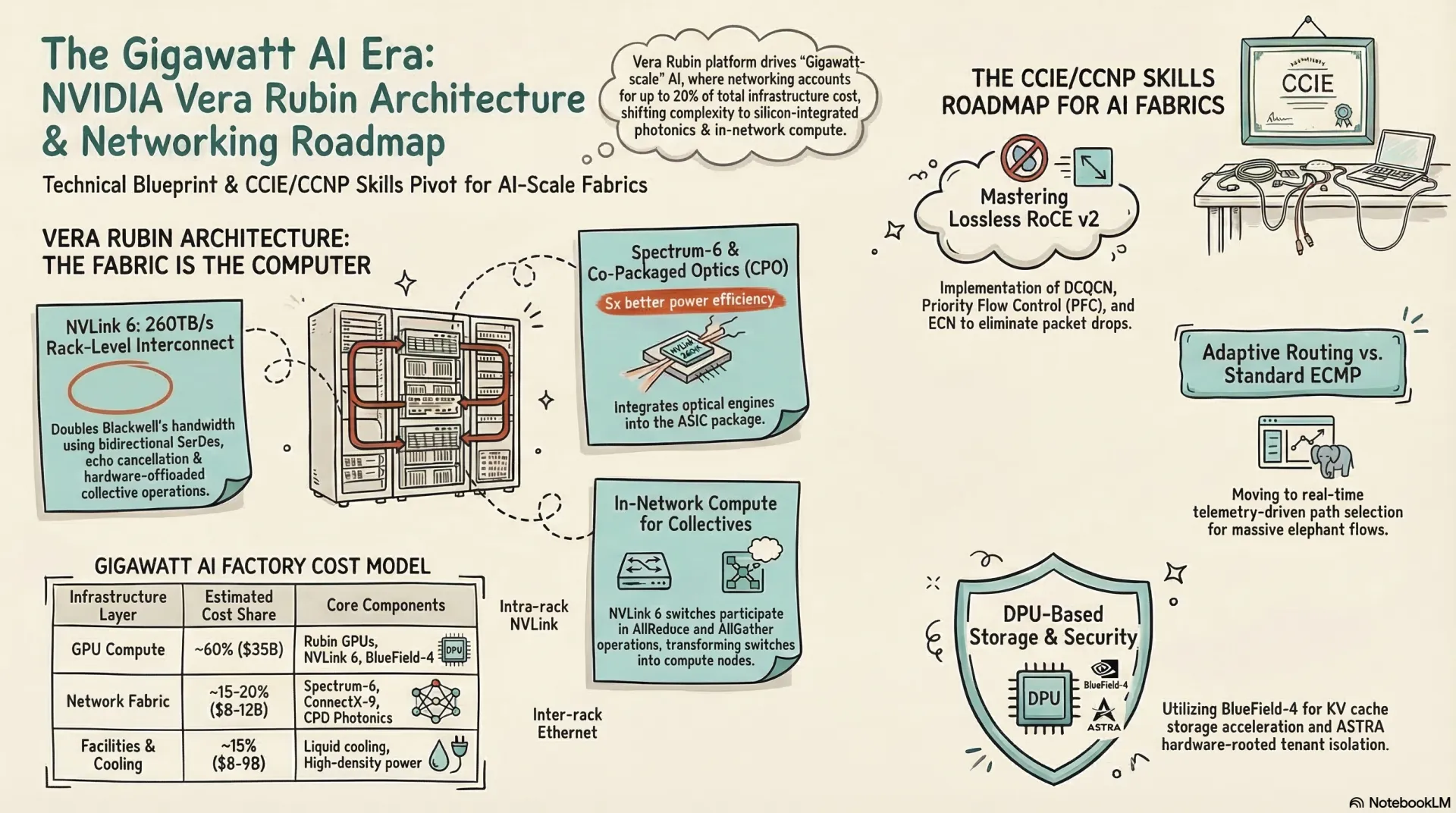
NVIDIA GTC 2026 Vera Rubin Platform Overview

NVIDIA GTC 2026: Vera Rubin, Gigawatt AI Deals, and What Network Engineers Must Know

NVIDIA GTC 2026 opened today in San Jose with 39,000 attendees and a clear message: AI infrastructure is entering the gigawatt era, and the network fabric connecting GPU clusters is now the single biggest differentiator between a functional AI factory and an expensive pile of silicon. The Vera Rubin platform — six co-designed chips delivering 260TB/s of rack-level bandwidth — rewrites the playbook for data center networking at every layer from NIC to spine switch. ...

March 16, 2026 · 10:27 AM MST · News & Trends
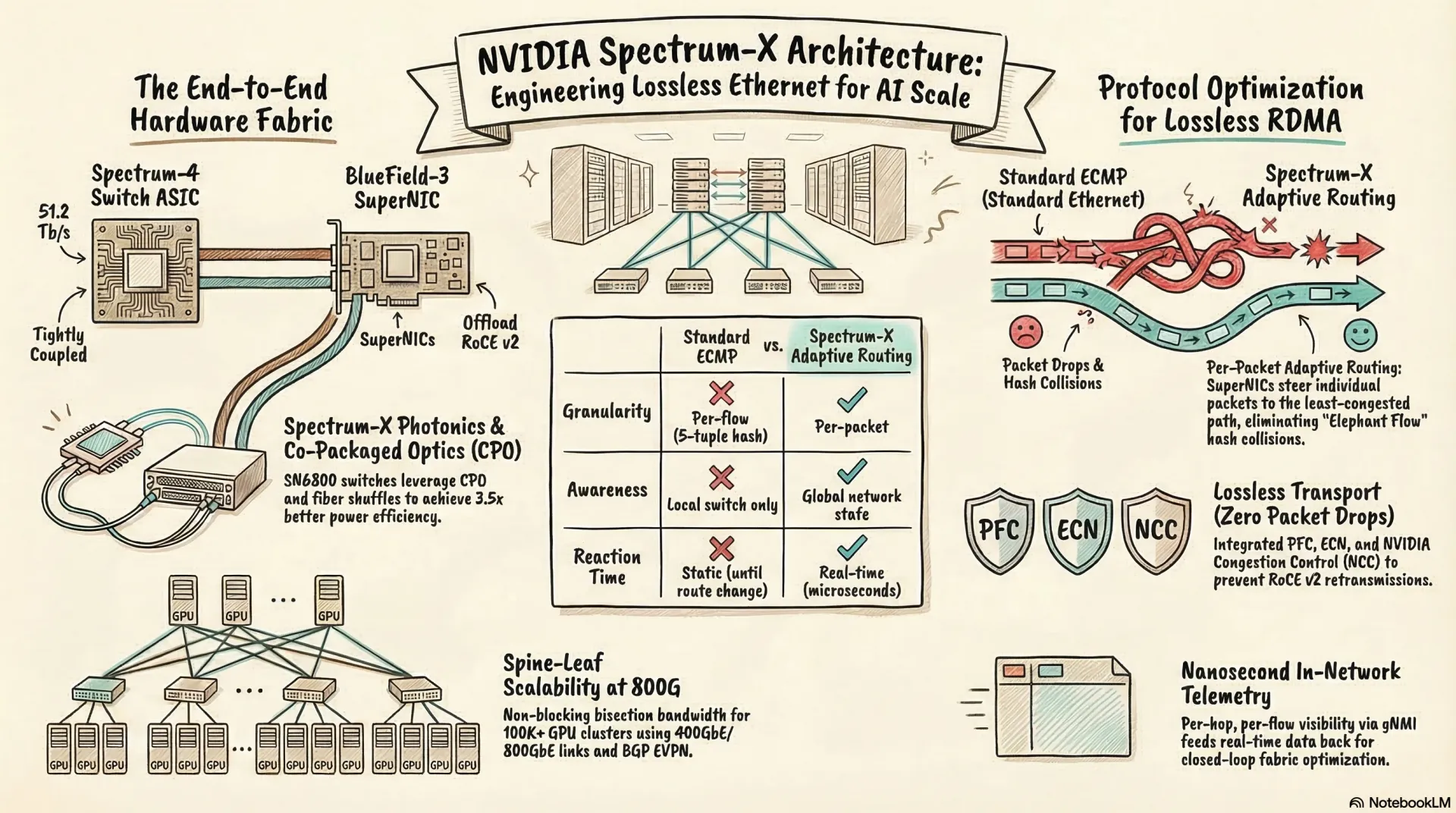
NVIDIA Spectrum-X Technical Architecture

NVIDIA Spectrum-X Deep Dive: How Ethernet Is Winning the AI Data Center Networking War in 2026

NVIDIA Spectrum-X is the platform that proved Ethernet can compete with InfiniBand for AI training workloads — and it’s winning. By tightly coupling Spectrum-4 switch ASICs with BlueField-3 SuperNICs, Spectrum-X achieves 1.6x better AI workload performance than off-the-shelf Ethernet while maintaining the cost, ecosystem, and operational advantages that made Ethernet the standard for everything else in the data center. Key Takeaway: Spectrum-X is not faster Ethernet — it’s a fundamentally different architecture that ports three InfiniBand innovations (lossless transport, adaptive routing, in-network telemetry) to Ethernet, and network engineers who understand these mechanisms will design the AI fabrics of the next decade. ...

March 15, 2026 · 5:00 PM MST · News & Trends
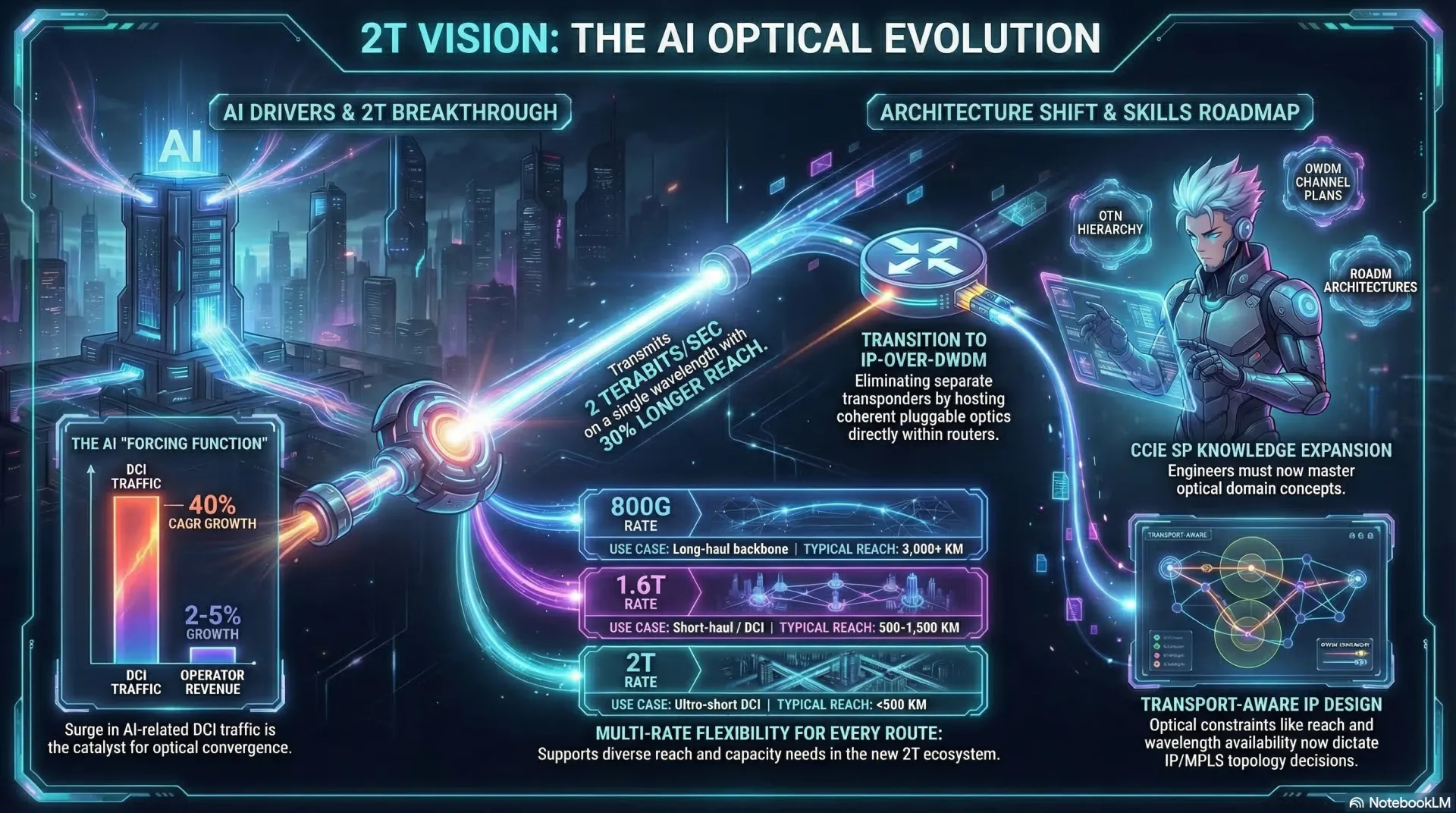
2T Vision: The AI Optical Evolution — Complete overview of Huawei's 2T optical solution and its impact on SP engineering

Huawei Launches the World's First Single-Wavelength 2T Optical Solution: What SP Engineers Need to Know

Huawei just demonstrated the world’s first single-wavelength 2 terabit-per-second optical solution at Mobile World Congress 2026. That’s 2T on a single DWDM wavelength — at a time when most production SP networks are still running 400G per wavelength and 800G is just ramping up. For service provider engineers, this isn’t just a speed record — it signals where the optical transport layer is heading and why it matters for the IP/MPLS networks you design on top of it. ...

March 14, 2026 · 8:00 PM MST · Service Provider

SoftBank's AI-Driven Routing Just Proved Intent-Based Networking Works — Here's What It Means for CCIE SP Engineers

SoftBank just deployed AI-driven autonomous routing on its commercial mobile network — and the results prove that intent-based networking isn’t just a blueprint concept anymore. Their “Autonomous Thinking Distributed Core Routing” technology, announced at MWC Barcelona 2026 on March 11, uses AI agents paired with the CAMARA Quality on Demand (QoD) API to dynamically select optimal network paths based on real-time traffic analysis. In field trials, it cut average latency from 41.9ms to 27.4ms with 99.7% traffic control accuracy. ...

March 11, 2026 · 2:00 PM MST · Service Provider

HPE's Networking Revenue Surges 152% After Juniper Acquisition: What It Means for Network Engineers in 2026

HPE’s networking business just posted the most eye-catching quarter in enterprise networking history: $2.7 billion in revenue, up 152% year-over-year, with a 23.7% operating margin. The Juniper Networks acquisition — which closed in July 2025 for $14 billion — is paying off faster than even HPE’s bulls expected, and it’s reshaping the competitive landscape that every network engineer operates in. Key Takeaway: The HPE-Juniper merger has created the first full-stack alternative to Cisco across campus, data center, security, and routing — and the financial results prove the market is buying it. Network engineers who build multi-vendor skills now will be positioned for the next decade of enterprise networking. ...

March 11, 2026 · 2:01 AM MST · News & Trends

Eridu's $200M Series A: Why a Networking Startup Is Redesigning AI Data Center Switches from Scratch

Eridu, an AI networking startup founded by serial entrepreneur Drew Perkins, emerged from stealth on March 10, 2026 with an oversubscribed $200 million Series A to build clean-sheet network switches with custom silicon designed from the ground up for AI data centers. The company argues that existing networking hardware — from Broadcom, Nvidia, Cisco, and Marvell — is hitting an architectural ceiling that incremental improvements can’t fix, and that connecting millions of GPUs requires a fundamentally different approach to switch design. ...

March 10, 2026 · 2:08 PM MST · News & Trends

Meta's $135 Billion AI Bet: Why Nvidia Spectrum-X Ethernet Is the Backbone of the Largest AI Buildout Ever

Meta is spending up to $135 billion on AI infrastructure in 2026 — the largest single-company technology investment in history — and the networking layer that ties it all together runs on Nvidia Spectrum-X Ethernet, not InfiniBand. This multiyear partnership covers millions of Nvidia Blackwell and next-generation Rubin GPUs, and the deliberate choice of Ethernet over InfiniBand sends a clear signal: the future of AI-scale networking is open, Ethernet-based, and built on the same fabric principles that CCIE-level engineers have been mastering for years. ...

March 10, 2026 · 2:01 PM MST · News & Trends

Hollow Core Fiber in AI Data Centers: Why 47% Lower Latency Changes Everything for Network Engineers

Hollow core fiber reduces data center interconnect latency by 30–47% compared to traditional single-mode fiber by transmitting light through air instead of glass. For AI training clusters distributing thousands of GPUs across multiple facilities, this latency reduction directly translates to higher GPU utilization, faster model convergence, and lower electricity bills. At MWC 2026, Senko demonstrated how HCF enables geographically distributed AI data center infrastructure — and Microsoft has already deployed it in production between Azure data centers in Europe. ...

March 9, 2026 · 2:01 PM MST · Data Center

STMicro's Silicon Photonics Hits Mass Production: What 800G/1.6T Co-Packaged Optics Mean for Network Engineers

STMicroelectronics just entered high-volume production of its PIC100 silicon photonics platform — the manufacturing technology behind the 800G and 1.6T optical modules going into every major AI data center buildout. For network engineers, this is the plumbing layer beneath your VXLAN EVPN overlays and BGP fabrics, and understanding it is becoming essential as data centers push past 400G. Key Takeaway: Silicon photonics and co-packaged optics are the technologies enabling AI data center fabrics to scale to 800G/1.6T per link while cutting power consumption by up to 70% — and network engineers who understand the optical layer will design better fabrics and troubleshoot faster. ...

March 9, 2026 · 8:00 AM MST · Data Center

RoCE vs InfiniBand for AI Data Center Networking: What Network Engineers Need to Know in 2026

RoCEv2 (RDMA over Converged Ethernet version 2) has emerged as the dominant networking technology for AI data centers that don’t need absolute peak performance at any cost. For most GPU cluster deployments in 2026, properly configured Ethernet with RoCEv2 delivers 85-95% of InfiniBand’s training throughput according to industry benchmarks — at significantly lower cost and with skills that network engineers already have. InfiniBand still wins for the largest training clusters, but Ethernet is closing the gap fast. ...

March 9, 2026 · 2:10 AM MST · News & Trends

The Data Center Is Dead, Long Live the AI Factory: What This Means for CCIE DC Candidates

The traditional data center as we knew it — racks of x86 servers running VMs, FCoE storage arrays, and oversubscribed network fabrics — is being replaced by something fundamentally different. In 2026, the industry’s biggest infrastructure investments are pouring into GPU-dense “AI factories” that demand network architectures built for massive east-west bandwidth, lossless transport, and deterministic latency. For CCIE Data Center candidates, this isn’t a threat — it’s the biggest career opportunity in a decade. ...

March 9, 2026 · 2:01 AM MST · Data Center

Every Networking Vendor Is Now an 'AI Company' — What That Actually Means for Your Career in 2026

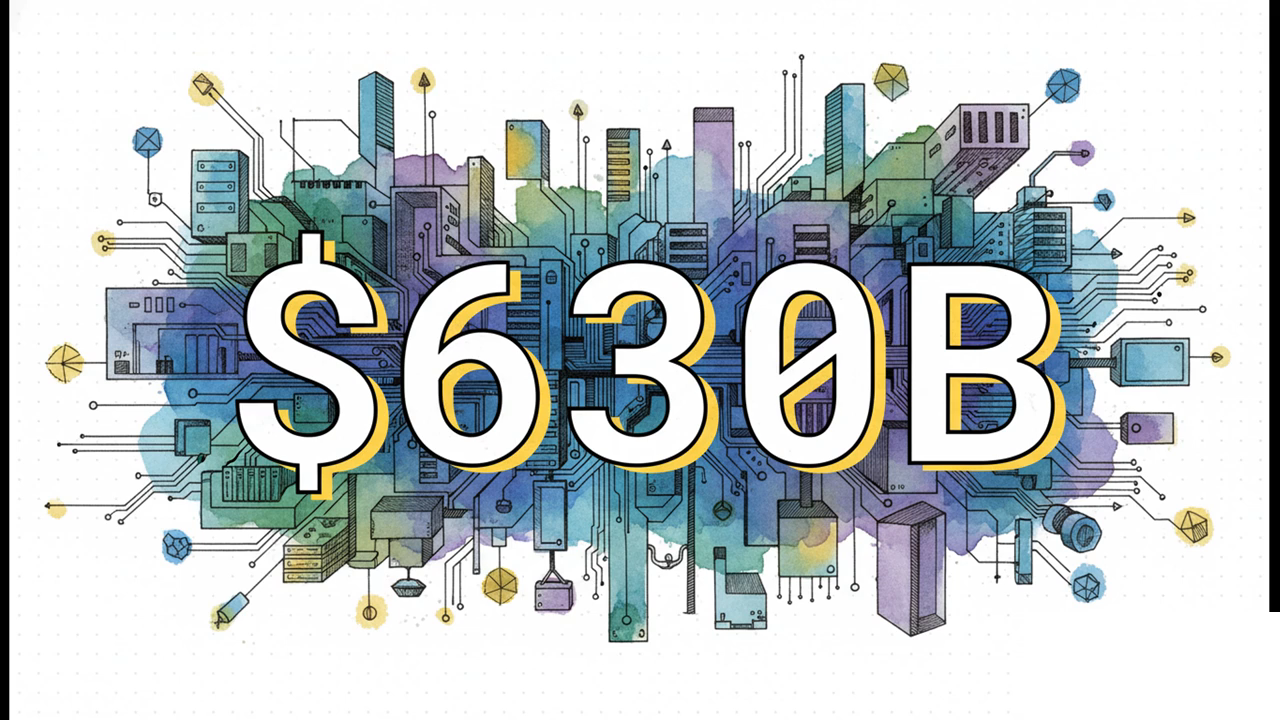
Cisco calls itself an “AI infrastructure leader.” HPE-Juniper is “AI-native networking.” Arista powers “AI data centers.” At MWC 2026, every networking vendor pitched an AI story. But when you strip away the marketing decks, what’s actually changed in the protocols you configure, the architectures you design, and the career bets you should make? Key Takeaway: The AI pivot is real at the revenue level — $630B+ in hyperscaler capex is flowing through networking vendors — but the skills that matter are protocol-level (VXLAN EVPN, BGP, RDMA/RoCE, 800G Ethernet), not vendor-specific AI branding. CCIE fundamentals aren’t going away; they’re becoming more valuable. ...

March 7, 2026 · 1:00 PM MST · News & Trends

AI Will Write Your Network Configs by 2028 — Why CCIE Automation Is Your Insurance Policy

Generative AI will handle 80% of routine network configuration tasks within two to three years. That’s not hype — it’s the trajectory that Gartner, Cisco, and every major vendor at MWC 2026 is projecting. But here’s what the “AI will replace engineers” crowd gets wrong: the engineers who understand the APIs, data models, and orchestration frameworks that AI plugs into won’t just survive — they’ll be the most valuable people in the room. ...

March 7, 2026 · 10:00 AM MST · News & Trends

Marvell Forecasts $15B Revenue on AI Data Center Boom: What Network Engineers Need to Know in 2026

Marvell Technology just projected fiscal 2028 revenue near $15 billion, blowing past Wall Street estimates on the back of explosive AI data center demand. For network engineers, this isn’t just a stock market story — Marvell silicon sits inside the switches, optics, and DPUs you configure every day. Understanding what’s driving this growth tells you exactly where data center networking is headed. Key Takeaway: AI workloads are fundamentally reshaping data center network architecture, and the silicon providers like Marvell building custom ASICs, 800G/1.6T optics, and DPUs are the clearest signal of where your career should be pointing. ...

March 6, 2026 · 9:36 AM MST · Data Center

Broadcom Predicts $100B AI Chip Market by 2027: What Network Engineers Must Learn Now

Broadcom’s AI chip business is on track to surpass $100 billion in annual revenue by 2027, according to CEO Hock Tan’s March 2026 earnings call. For network engineers, this isn’t just a semiconductor headline — it’s a signal that demand for high-speed data center fabric expertise is about to explode. Every dollar spent on AI silicon requires corresponding investment in 800G switching, lossless Ethernet fabrics, and EVPN-VXLAN overlays to connect those chips. ...

March 6, 2026 · 2:00 AM MST · News & Trends

Cisco's $2.1 Billion AI Infrastructure Orders: Why Your CCIE Enterprise Skills Just Became Gold

Cisco just booked $2.1 billion in AI infrastructure orders from hyperscalers in a single quarter — up from $1.3 billion the quarter before. Their networking product orders surged over 20% year-over-year. If you hold a CCIE Enterprise Infrastructure or you’re studying for one, your skills just became significantly more valuable. The “networking is boring” era is officially dead. Key Takeaway: AI workloads are driving the biggest networking investment cycle in a decade, and the protocols tested on the CCIE EI lab — BGP, VXLAN/EVPN, SD-WAN, QoS — are exactly what hyperscalers and enterprises need to build AI-ready infrastructure. ...

March 5, 2026 · 2:07 PM MST · Enterprise Infrastructure