CCIE Security

The End of the Perimeter: Why Managed SASE and Universal ZTNA Rule 2026
Managed SASE and universal ZTNA rule 2026 because the old perimeter model no longer matches how enterprise networks are actually used. Users move between home, branch, mobile, and cloud; applications live across SaaS and private environments; and the biggest remote-access risk is no longer whether a user can connect, but whether you can enforce identity, posture, and least privilege on every request. Key Takeaway: The winners in 2026 are not the teams with the biggest VPN concentrators. They are the teams that can apply one identity-driven policy model across users, devices, private apps, SaaS, branches, and unmanaged edge systems. ...

Forescout Identity-Driven Segmentation for Multi-Vendor Networks: What CCIE Security Engineers Should Care About in 2026
Forescout’s March 23, 2026 segmentation release matters because it moves network security discussions away from static IP ranges and toward identity, behavior, and risk across mixed environments. For CCIE Security engineers, the real story is not the press release headline, it is that vendor-agnostic segmentation is becoming a practical answer to zero-trust enforcement in networks that include Cisco, Arista, OT controllers, medical gear, unmanaged IoT, and assets that will never run an agent. ...

How to Build a Cisco ISE 3.x Lab on EVE-NG: Step-by-Step for CCIE Security Candidates
A usable Cisco ISE 3.x lab on EVE-NG is absolutely worth building for CCIE Security, because ISE shows up in authentication, policy, TrustSec, and operational troubleshooting far more often than most candidates expect. According to Cisco’s ISE 3.3 Installation Guide (2026), the evaluation baseline is 4 vCPU, 16 GB RAM, and 300 GB disk, but in real EVE-NG use most candidates should allocate 8 vCPU if they want the GUI, policy changes, and endpoint tests to feel responsive instead of miserable. ...

FCC Bans Foreign-Made Routers: What Enterprise Network Engineers Must Do Now
The FCC banned all new foreign-made consumer routers from US import and sale effective March 23, 2026, citing “unacceptable” supply chain and cybersecurity risks. The order adds every consumer-grade router manufactured outside the United States to the FCC’s Covered List, blocking new device authorizations unless the Department of Defense or Department of Homeland Security grants a specific exemption. For enterprise network engineers, this is not just a consumer story — it is a forcing function that exposes how dangerously the remote edge depends on hardware you do not control. ...

Cato Neural Edge: How GPU-Powered SASE Changes Network Security Architecture
Cato Networks just made the most significant architectural bet in the SASE market: embedding NVIDIA GPUs directly inside every one of its 85+ global Points of Presence. The new Cato Neural Edge platform eliminates the traditional gap between traffic inspection and AI-driven analysis by running both in the same location, at the same time, in a single pass. For network security engineers — especially those pursuing or holding CCIE Security — this represents a fundamental shift in how cloud-delivered security perimeters will operate going forward. ...

FlexVPN vs DMVPN for CCIE Security: Which VPN Framework Should You Master?
FlexVPN and DMVPN are the two VPN frameworks that define Cisco’s site-to-site and remote access tunnel architectures — and the CCIE Security v6.1 lab tests both extensively. FlexVPN, built on IKEv2 (RFC 7296), unifies site-to-site, hub-and-spoke, and remote access VPN under a single CLI framework with smart defaults that cut configuration by 60-70%. DMVPN, the mGRE + NHRP + IPsec overlay that has dominated enterprise branch networking since IOS 12.4, still powers over 70% of production branch VPN deployments according to Cisco’s enterprise networking data. ...

FCC Bans Foreign Routers: What Enterprise Network Engineers Must Do Now
The FCC banned all new foreign-made consumer routers from receiving equipment authorization effective March 23, 2026, citing direct involvement of foreign-produced routers in the Volt, Flax, and Salt Typhoon cyberattacks that targeted US critical infrastructure. This is the most sweeping addition to the FCC’s Covered List since the Secure and Trusted Communications Networks Act of 2019 — and unlike previous entries that targeted specific companies like Huawei and ZTE, this ban applies categorically to every router produced outside the United States. ...

SASE Spending Projected to Hit $97 Billion by 2030: What Network Engineers Need to Know
Cumulative SASE spending across Security Service Edge (SSE) and SD-WAN will reach $97 billion over the 2025–2030 period, according to Dell’Oro Group’s February 2026 forecast. That figure is nearly three times the total SASE investment recorded during 2020–2024, signaling a structural shift from appliance-based network security to cloud-delivered architectures. For network engineers holding or pursuing CCIE Security, this acceleration creates both urgency and opportunity — the skills that defined network security for two decades are being reshaped around SASE-native design patterns. ...
Cisco FMC Zero-Day CVE-2026-20131 Exploited by Interlock Ransomware: What Network Security Engineers Must Do Now
CVE-2026-20131 is a CVSS 10.0 critical vulnerability in Cisco Secure Firewall Management Center (FMC) that allows unauthenticated remote attackers to execute arbitrary code as root through an insecure deserialization flaw in the web management interface. The Interlock ransomware group exploited it as a zero-day for 36 days before Cisco disclosed and patched it on March 4, 2026. If you run FMC to manage your FTD firewalls, stop reading and patch now — then come back. ...
Tenzai's AI Hacker Beat 99% of Humans in CTF Competitions — What Network Security Engineers Must Do Now
Tenzai’s autonomous AI hacker outperformed 99% of 125,000 human competitors across six elite capture-the-flag hacking competitions in March 2026, completing multi-step exploit chains for an average cost of $12.92 per platform. This isn’t a research demo — it’s a production-grade offensive AI system built by Israeli intelligence veterans with $75 million in seed funding and a $330 million valuation, and it fundamentally changes the threat model that every network security engineer must defend against. ...
AWS Bedrock DNS Exfiltration Flaw: What Network Engineers Need to Know About Cloud AI Sandbox Security
AWS Bedrock AgentCore Code Interpreter allows attackers to exfiltrate sensitive data using DNS queries even when running in “Sandbox” mode — and AWS says this is intended behavior, not a vulnerability. Security researchers from Phantom Labs and Sonrai Security have independently demonstrated that DNS resolution capabilities bypass sandbox isolation, enabling credential theft, S3 bucket enumeration, and full command-and-control channels through a protocol that every firewall permits by default. Key Takeaway: If your organization deploys AI agents with code execution capabilities in AWS, the word “sandbox” does not mean what you think it means — DNS-based exfiltration works regardless of network mode, and overpermissioned IAM roles turn a DNS covert channel into a full data breach. ...
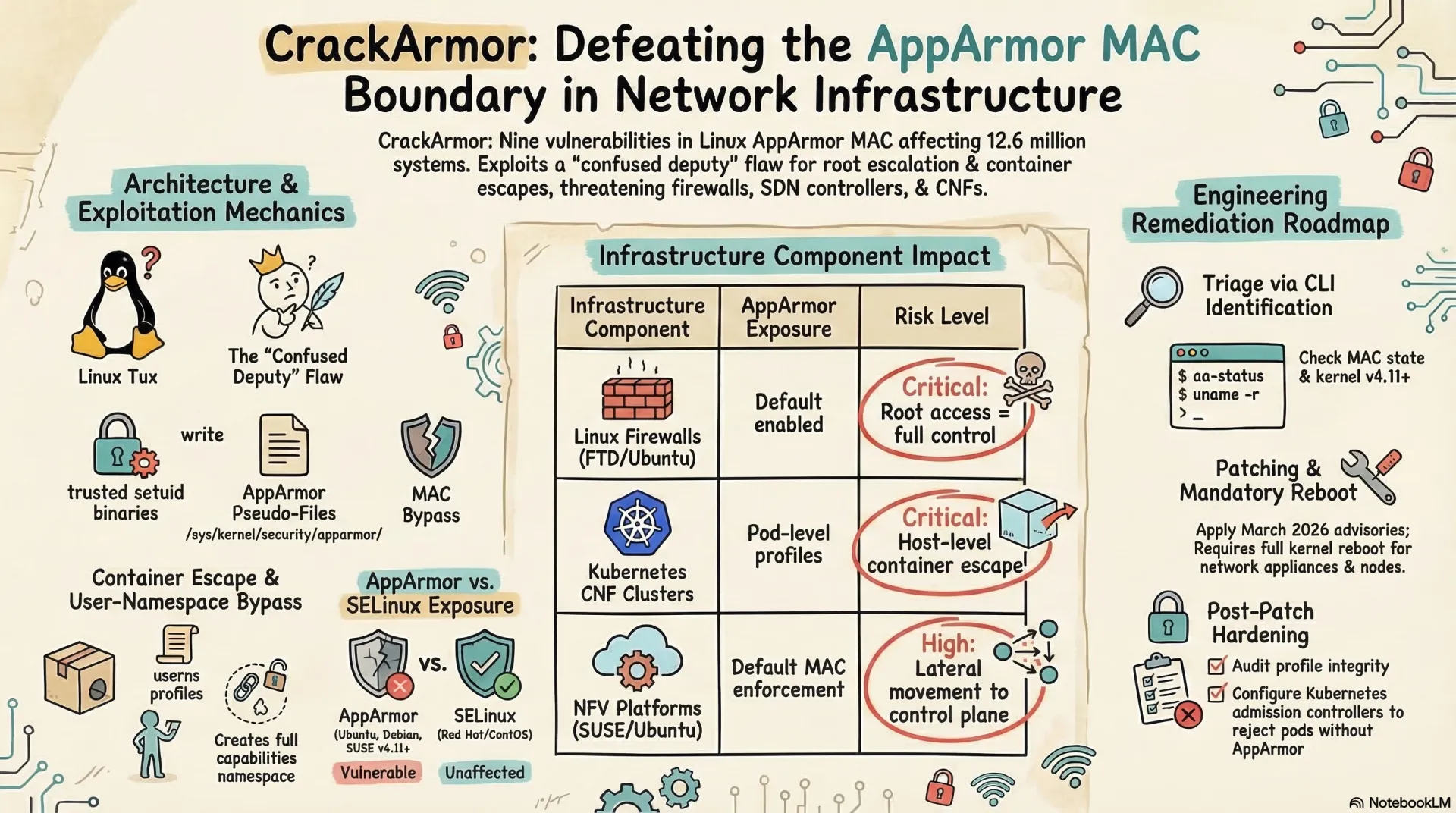
Linux AppArmor CrackArmor Vulnerabilities: What Network Security Engineers Must Do Now
Nine critical vulnerabilities in Linux AppArmor — collectively dubbed “CrackArmor” by the Qualys Threat Research Unit — allow any unprivileged local user to escalate privileges to root, break container isolation, and crash entire systems. According to Qualys (2026), over 12.6 million enterprise Linux instances run with AppArmor enabled by default, and these flaws have existed since kernel v4.11, released in April 2017. If you run network infrastructure on Ubuntu, Debian, or SUSE — and statistically, many of your appliances do — this is a patch-now situation. ...
Fortinet and Ivanti March 2026 CVEs: What Network Security Engineers Must Patch Now
Fortinet dropped 22 security patches on March 11, 2026, including a FortiOS authentication bypass (CVE-2026-22153) that lets unauthenticated attackers slip past LDAP-based VPN and FSSO policies. The same patch cycle addresses a heap buffer overflow (CVE-2025-25249) in FortiOS and FortiSwitchManager enabling remote code execution. Ivanti simultaneously patched a high-severity auth bypass in Endpoint Manager. If you manage FortiGate firewalls, Ivanti EPM, or Intel-based infrastructure, you need to act on these this week. ...
MACsec (802.1AE) Explained: Wire-Speed Encryption for Campus and Data Center Networks in 2026
MACsec (802.1AE) is the only IEEE standard that encrypts Ethernet frames at wire speed with zero performance penalty. It operates at Layer 2, encrypting everything between two directly connected devices — switch to host, switch to switch, or switch to router. Despite being the most effective encryption technology available for campus and data center networks, most network engineers have never configured it. Key Takeaway: MACsec is the encryption layer that makes zero trust architectures real at the network level — it protects data in transit on every link, at line rate, without the CPU overhead of IPsec or the application dependency of TLS. It’s on the CCIE Security v6.1 and CCIE EI v1.1 blueprints, and understanding it separates security-aware network engineers from everyone else. ...
How to Build a Cisco FTD + FMC Firewall Lab on EVE-NG: Step-by-Step for CCIE Security
Building a Cisco FTD and FMC lab on EVE-NG gives you a free, fully functional environment to practice the firewall configuration that makes up roughly 40% of the CCIE Security v6.1 lab exam. This guide walks you through every step — from importing qcow2 images to deploying your first access control policy with NAT rules. Key Takeaway: FTD/FMC hands-on practice is non-negotiable for CCIE Security candidates, and EVE-NG provides the most cost-effective way to build a production-realistic lab environment on commodity hardware. ...
Trump's Cyber Strategy for America 2026: What Network Engineers Need to Know
Trump’s “Cyber Strategy for America,” released on March 6, 2026, is a seven-page national cybersecurity blueprint that puts offensive cyber operations front and center, mandates zero trust modernization across all federal networks, and signals the biggest federal cybersecurity hiring wave in a decade. For network engineers, this is not just policy news — it is a career signal. Key Takeaway: The strategy’s six pillars — especially the mandates for zero trust architecture, post-quantum cryptography, and AI-powered defenses — translate directly into job demand for engineers with CCIE Security skills, ISE deployment experience, and federal network modernization expertise. ...
Cisco ISE + TrustSec Zero Trust Segmentation: The Complete Network Engineer's Guide for 2026
Cisco ISE combined with TrustSec is the most widely deployed zero trust network segmentation solution in enterprise environments today. It uses Scalable Group Tags (SGTs) to enforce identity-based access policies across switches, routers, and firewalls — replacing thousands of IP-based ACLs with a centralized policy matrix that follows users and devices wherever they connect. Key Takeaway: TrustSec SGT-based segmentation is the practical implementation of zero trust that enterprises are actually deploying in 2026, and mastering it is essential for both production network engineers and CCIE Security candidates. ...
Google's 2025 Zero-Day Report: Half of All Exploited Vulnerabilities Targeted Enterprise Networks
Google’s Threat Intelligence Group (GTIG) tracked 90 zero-day vulnerabilities exploited in the wild in 2025, with 43 of them — nearly half — targeting enterprise networking and security infrastructure. This represents an all-time high for enterprise-focused zero-days and a clear signal that the devices network engineers manage daily are now the primary attack surface. Key Takeaway: Network appliances like firewalls, VPN concentrators, and SD-WAN controllers have replaced endpoints as the top zero-day target. If you manage Cisco ASA, FTD, or any edge device, this report is your wake-up call. ...
Zero Trust Will Make Half the CCIE Security Blueprint Obsolete by 2028 — Here's What Survives
Half of what’s on the CCIE Security v6.1 blueprint will be irrelevant in production networks by 2028. Traditional perimeter defenses — zone-based firewalls, static ACLs, VPN-centric architectures — are being replaced by identity-driven, continuous-verification security models. But here’s the counterintuitive part: CCIE Security v6.1’s heavy focus on Cisco ISE actually positions certified engineers better for the zero trust future than most people realize. Key Takeaway: Zero trust is killing traditional perimeter security, not the CCIE Security certification. The v6.1 blueprint’s emphasis on ISE, TrustSec, and identity-based access control maps directly to zero trust principles — making CCIE Security holders more valuable, not less. ...
CCIE Security Salary in 2026: What ISE and Firepower Engineers Actually Earn
CCIE Security holders earn $140,000 to $250,000+ in 2026, with the average sitting at $175,000 — roughly $13,000 more than the overall CCIE average across all tracks. For ISE and Firepower engineers specifically, the CCIE Security certification creates a salary premium that no other Cisco track matches. Key Takeaway: CCIE Security is the highest-paying CCIE track in 2026, with senior ISE and Firepower architects earning $200,000–$250,000+ — a 15–20% premium over CCIE Enterprise Infrastructure holders. ...
From CCNP to CCIE Security: The Realistic Timeline (3 Months or 3 Years?)
The honest answer to “How long from CCNP to CCIE Security?” is somewhere between 6 months and 3 years — and the variance has almost nothing to do with how smart you are. It’s determined by three factors: your hands-on ISE/FTD production experience, your daily study hours, and whether you’ve built realistic lab topologies or just watched videos. I’ve seen engineers with 5+ years of security operations pass in 6 months of focused preparation, and I’ve seen talented engineers with no ISE background struggle for 2+ years. ...
Cisco SD-WAN Under Siege: Two More Catalyst Vulnerabilities Now Actively Exploited (March 2026)
Cisco just expanded the list of actively exploited Catalyst SD-WAN vulnerabilities — and if you haven’t patched yet, you’re running out of time. On March 5, 2026, Cisco updated its advisory to confirm that CVE-2026-20128 and CVE-2026-20122 are now being exploited in the wild, bringing the total number of actively exploited SD-WAN flaws to three in just eight days. Combined with the critical CVE-2026-20127 zero-day disclosed on February 25, this represents a sustained campaign against SD-WAN infrastructure that every network engineer needs to take seriously. ...
Cisco Patches 48 ASA, FTD, and FMC Vulnerabilities in March 2026: What CCIE Security Candidates Must Know
Cisco dropped one of its largest security patch bundles in recent memory on March 4, 2026 — 25 advisories covering 48 vulnerabilities across Secure Firewall ASA, Secure FTD, and Secure FMC. Two of those flaws score a perfect CVSS 10.0. If you’re studying for CCIE Security, these are the exact platforms you’ll face on exam day, and understanding how they break is just as important as knowing how to configure them. ...
Cisco SD-WAN Zero-Day CVE-2026-20127: What Every CCIE Candidate Needs to Know in 2026
CVE-2026-20127 is a maximum-severity (CVSS 10.0) authentication bypass vulnerability in Cisco Catalyst SD-WAN that has been actively exploited since 2023. Disclosed on February 25, 2026, it allows an unauthenticated remote attacker to bypass peering authentication on vSmart Controllers and vManage, gain admin-level access, reach the NETCONF interface, and manipulate routing and policy across an entire SD-WAN fabric. Five Eyes intelligence agencies issued a coordinated emergency advisory the same day, and CISA added it to the Known Exploited Vulnerabilities catalog within hours. ...
CCIE Security v6.1 Lab Prep: The ISE-Heavy Reality and How to Survive It
If you’re preparing for the CCIE Security v6.1 lab exam, here’s the uncomfortable truth that nobody tells you upfront: Cisco Identity Services Engine (ISE) dominates roughly 40% of the entire lab exam. Not firewalls. Not VPNs. ISE. This catches most candidates off guard. They spend months perfecting ASA configs and FlexVPN tunnels, walk into the lab, and discover that ISE authentication policies, profiling, posture assessment, and TrustSec SGT propagation consume nearly half their 8-hour exam window. ...
Cisco ASA vs FTD for CCIE Security v6.1: Which Platform to Master First
Every CCIE Security v6.1 candidate hits the same question early in their prep: do I master ASA first, or dive straight into FTD? Reddit threads are full of conflicting advice. Some candidates say FTD dominates the lab. Others insist ASA fundamentals are non-negotiable. The truth — as usual — is more nuanced than either camp admits. I’ve spent significant time dissecting the v6.1 blueprint, lab reports from recent candidates, and the actual platform behaviors you’ll encounter under exam pressure. Here’s the definitive breakdown. ...